Phetchaburi


"A nation's culture resides in the hearts and in the soul of its people."
Mahatma Gandhi
Phetchaburi is the provincial capital of Phetchaburi province which occupies central Thailand, sits at the top of the Thai peninsula, and is home to some 30,000 people. The name Phetchaburi means "City of Diamonds" and we certainly found that to be true. The people were the diamonds in this place. This was one of our most enjoyable stays in Thailand, not least because of the kindness of the people we met, and the fact that it is a quiet, small town vibe where you really felt like you were seeing the Thai way of life.
Although it has some major attractions. most people come on day trips from Bangkok and so there are less tourists staying in the town. We saw few non Thai tourists but there was a healthy population of Thai visitors. They love their country and their heritage and often day trip around the sites. It helped we were off season I am sure.
Phetchaburi is known for its traditional Thai desserts and is recognised by UNESCO as a creative city of gastronomy.


APlus Hometel
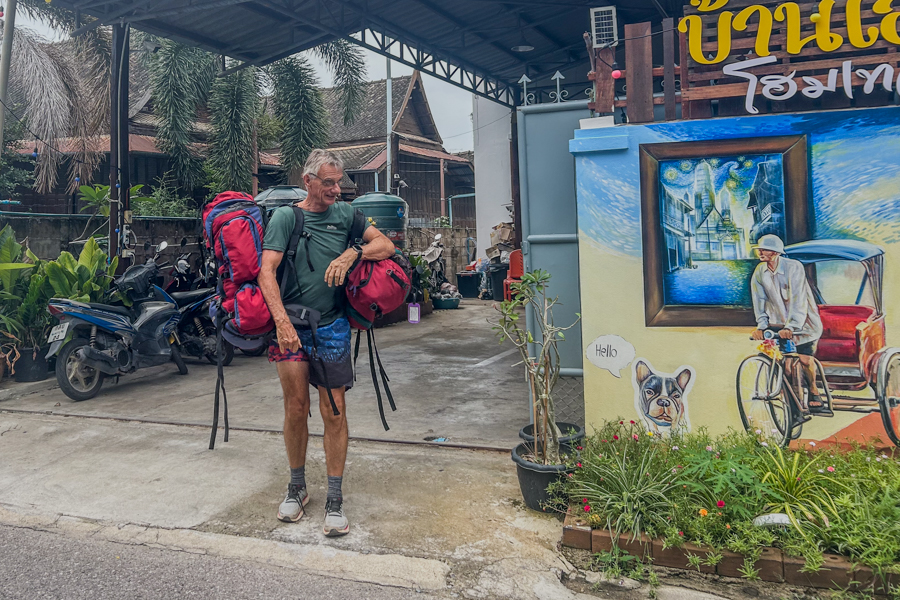


We arrived in Phetchaburi after a 2 hour shared minibus taxi ride. They dropped us on a busy street and we had no idea where we were. A young man at the taxi rank took pity on us and ordered a taxi on his Grab app to take us to the hostel, APlus Hometel. We really need to work out how to use these things but the muppet impersonation worked and we were waved on our way.
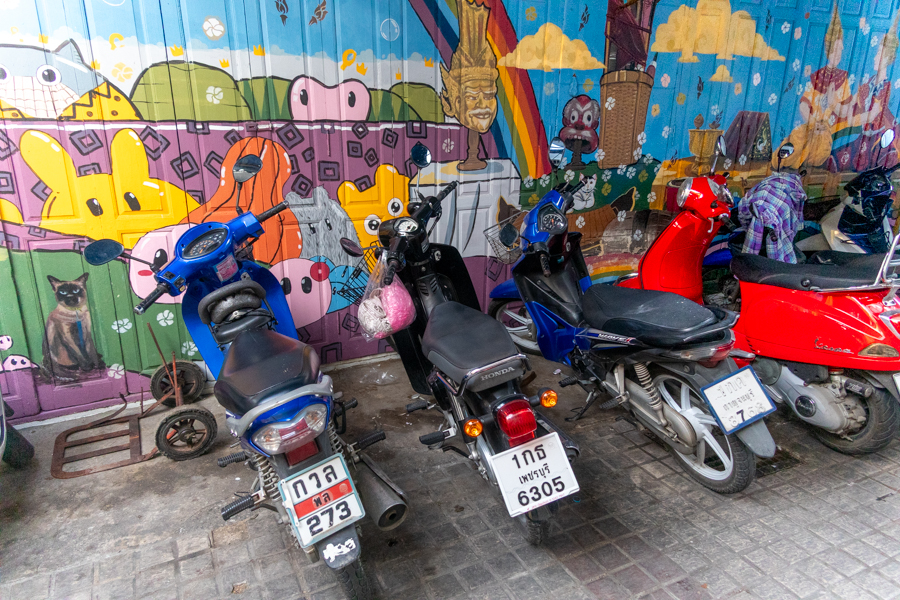
I booked the hostel because of the cute Thainglish name and because all the pictures showed a bunch of cartoon street art on the walls. What is not to like? Also they offered breakfast.
We arrived around 1.00 pm and were greeted by the owner and shown around. June, the daughter, had better English and she came and explained everything later.
The house was on the river and right in the middle of the old town. You entered a courtyard full of scooters and bikes and a small glassed in office where the family used to hang out, rather like a parking booth. At the back of the courtyard was an old Thai house with 3 stories and a court yard with a covered patio, next to the river, where breakfast was served. A little kitchen was tacked on the back.
Like most of these traditional Thai houses it looks like bits have been added over time so it's a bit of a house that Jack built. These houses have often been in the families for generations and as the generations grew then additions were made. Often many generations are living together on the property.

Here at APlus there was a family of 3, mom, dad and their youngest daughter, June, who helped run the hostel. They were of Chinese heritage. Dad was an engineer and mum a business manager, but they had left the big city to run the family home. They were so friendly, they fully embraced the idea that helping their guests experience the best of Phetchaburi was a privilege. They loved their town and were particularly proud of the cuisine.
We had a double room which would have been spacious if it were not for 2 king sized beds squashed in side by side.
Generational eclectic family furniture completed the homey atmosphere.
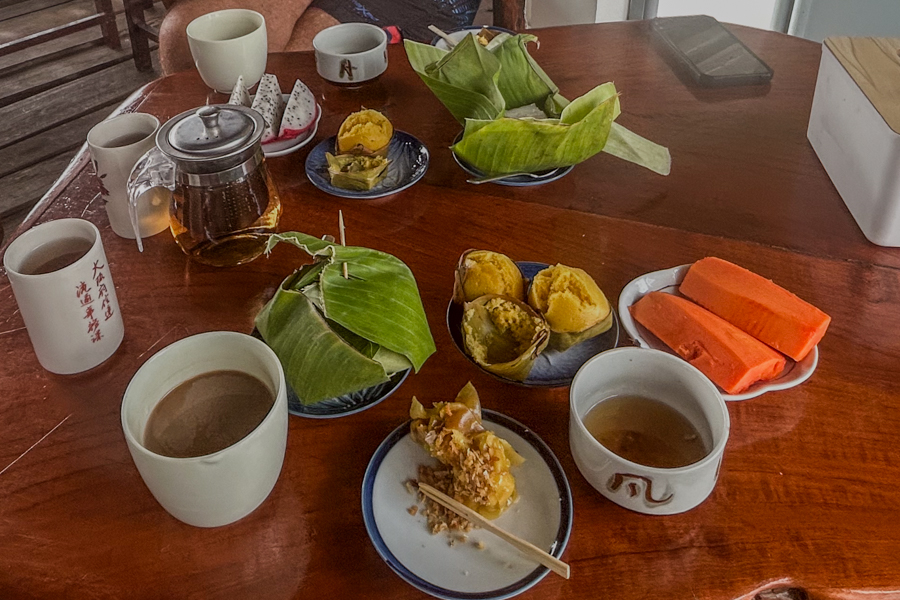
Like everywhere else we went, it was comfortable and clean. Every morning they made breakfast for us which always consisted of a multi course tasting menu of Phetchaburi special foods.
They must have gotten up very early to go to the morning market to find most of these things. They were unusual but often delicious and things we would not have known to try if we had relied on ourselves. A sweet custard featured quite prominently in many dishes as this is one of the Phetchaburi specials.
They gave us a hand drawn map of the town and lots of advice on the places to visit, the cafes and noodle houses included.


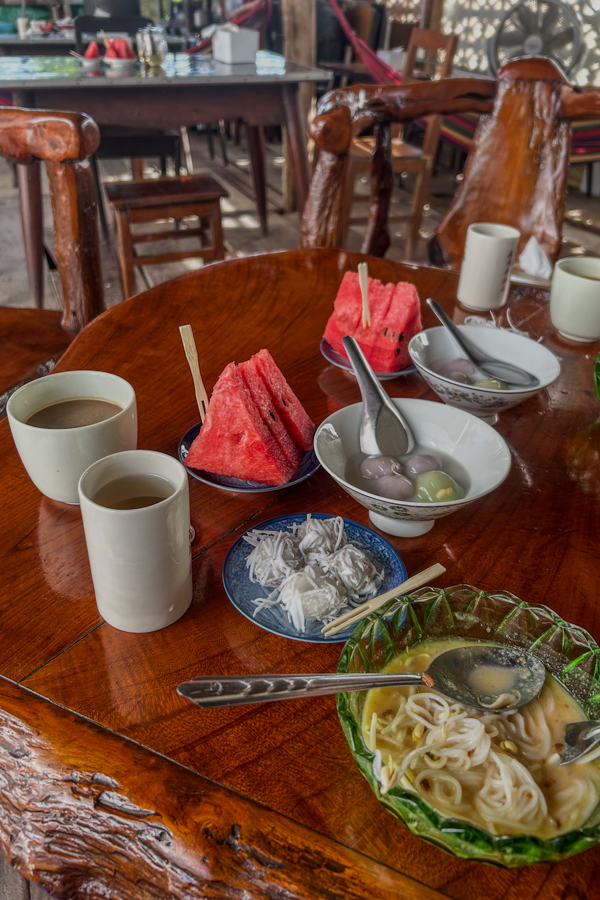

Breakfast
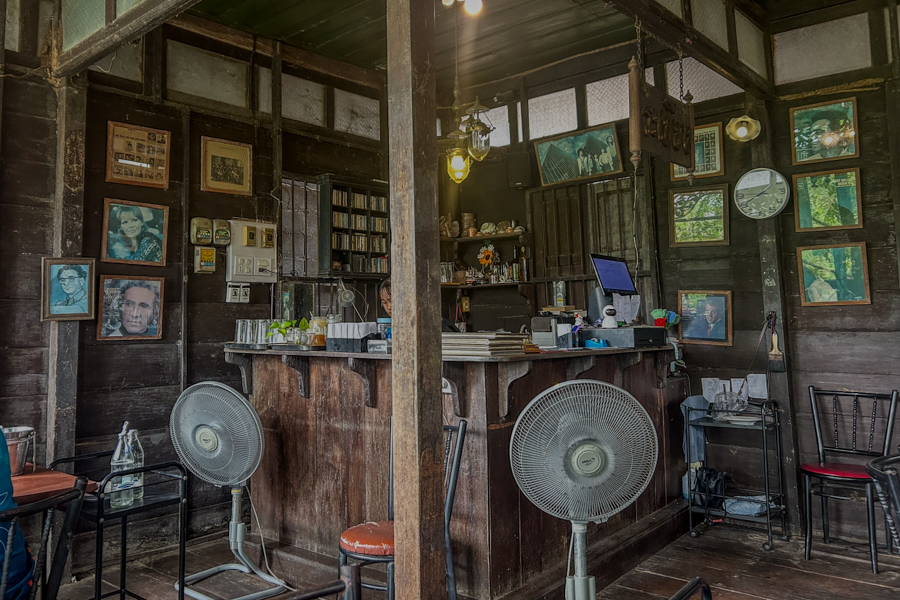
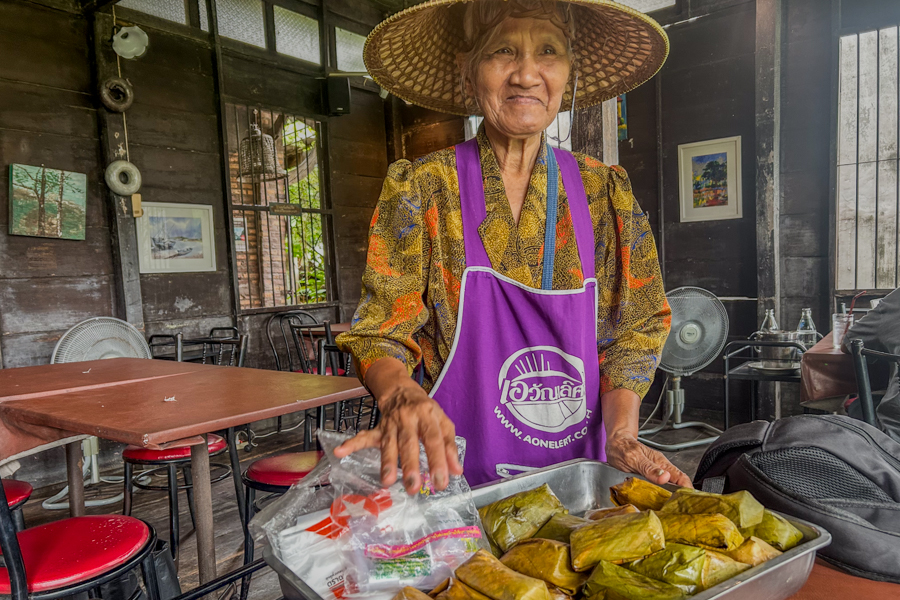
Bikes were again on offer free of charge but I remained nervous of my skills and the traffic. It did not matter, we were able to walk almost everywhere. We had a beautiful cool coffee shop 2 doors down called Pagoda and an old restaurant on the river bank in a restored Thai house called Rabieng Rimnum in the opposite direction. Local delicacies included palm fruit curry and sticky rice with banana. Coffee costs about as much as supper, but I think you are paying for the aircon. All the coffee shops have icy aircon, the best place to get out of the heat in the day.
They did our laundry for us and they called taxis when we needed them.
Just down the road was a foot bridge across the river, opposite a beautiful temple, indeed we were surrounded by temples.
Beyond all this, when we needed a lift to the airport 100 km away, and unable to find transport at the right time, they pulled their ancient car out of the the garage and gave us a lift, taking us to their favourite Chinese temple on the way.
They stole our hearts with their smiling faces and generosity of spirit, and so we left just a little bit of ourselves in the quiet streets of Phetchaburi, at APlus Hometel.

Rabieng Rimnum and the old lady selling us banana and sticky rice parcels.

The house with the blue roof on the right is APlus Hometel
Phetchaburi Markets

The Night Market
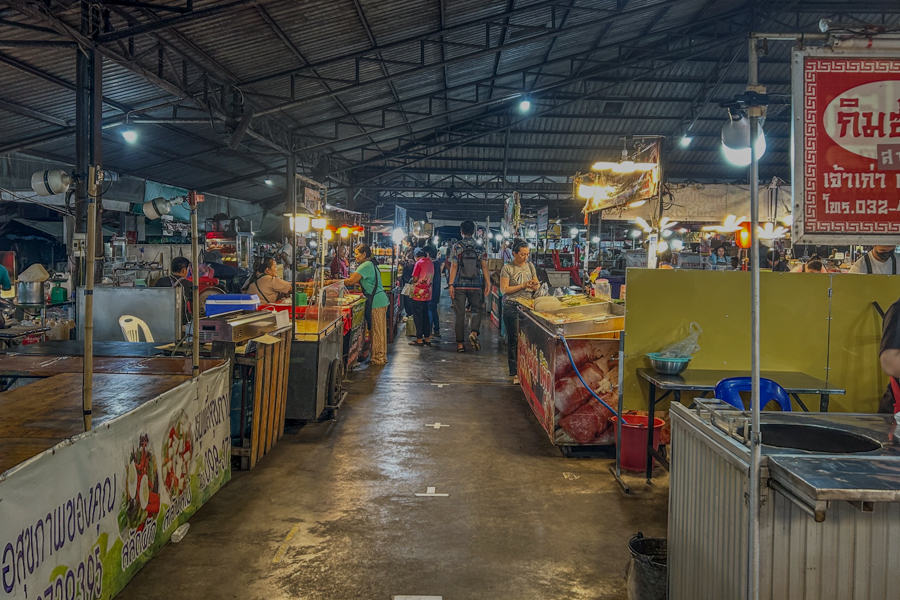
Our first evening we set off to walk to the local night market for our supper. It was about 2 km away and was under canvas at a road intersection. Music played and everyone was there getting food but there were few foreigners and no one seemed to speak English.
We were a bit wary about the food but eventually found kebabs which were being cooked in front of us and we feasted on chicken and okra and mushrooms and washed it down with rainbow donuts and soda, The rains arrived and we walked home jumping puddles and dodging scooters.
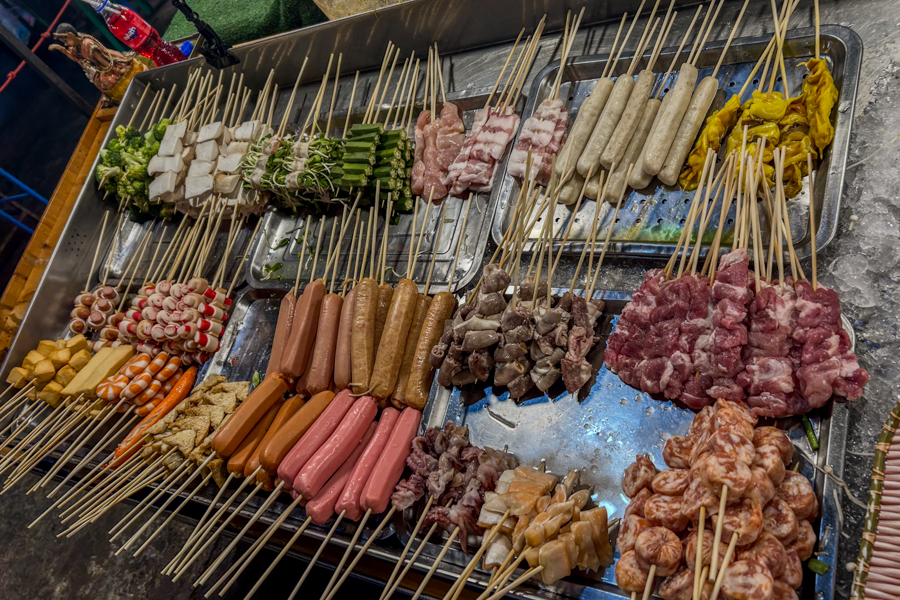
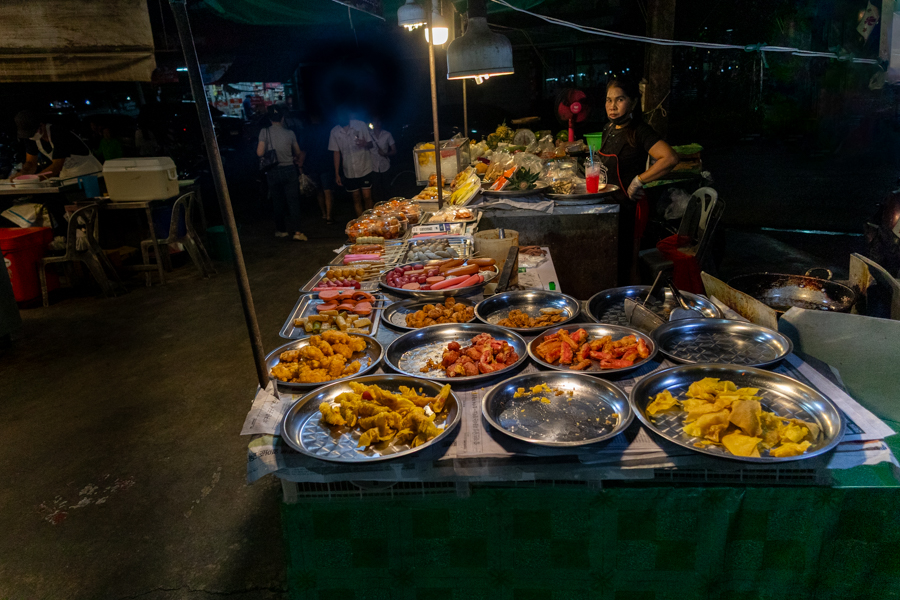
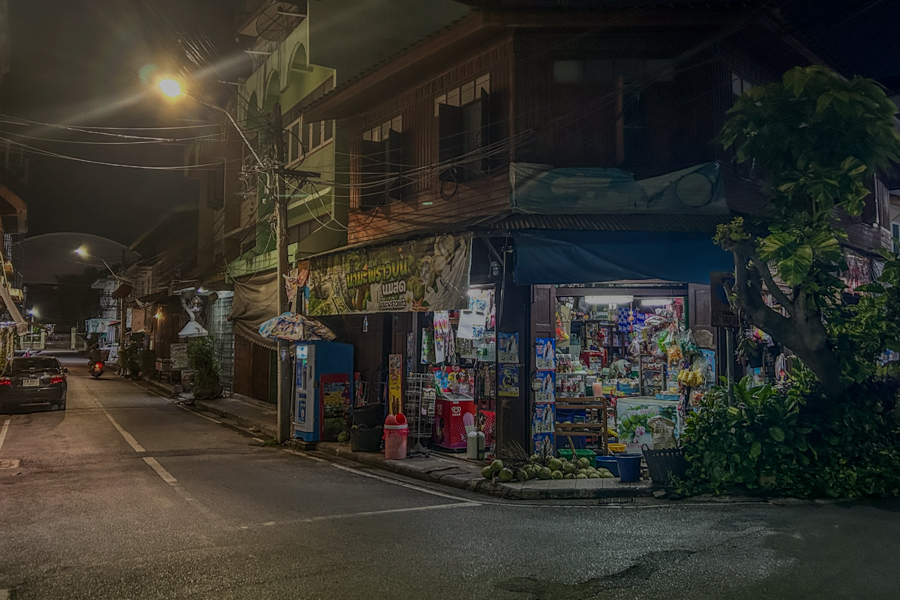
Next day we planned to get up for the early morning market on the other side of the river.
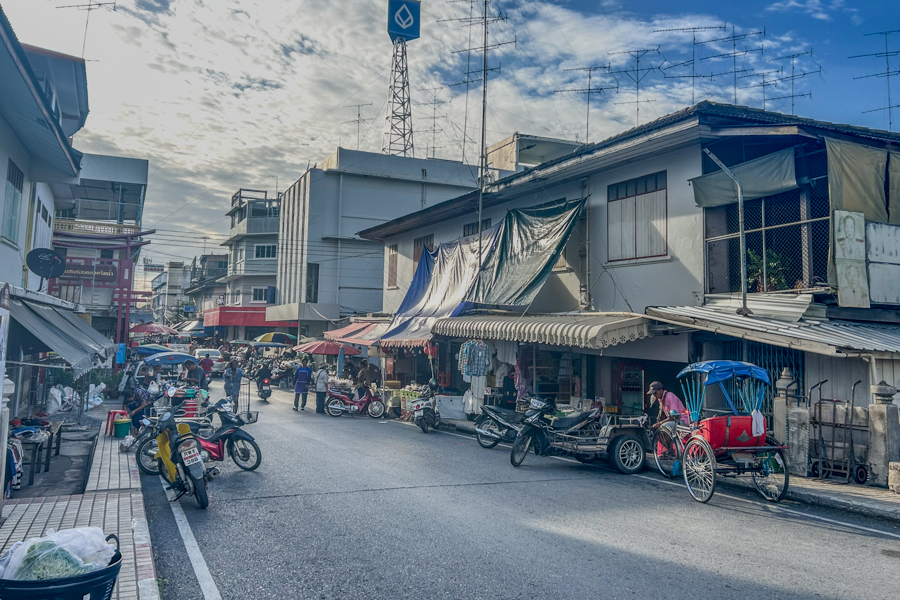
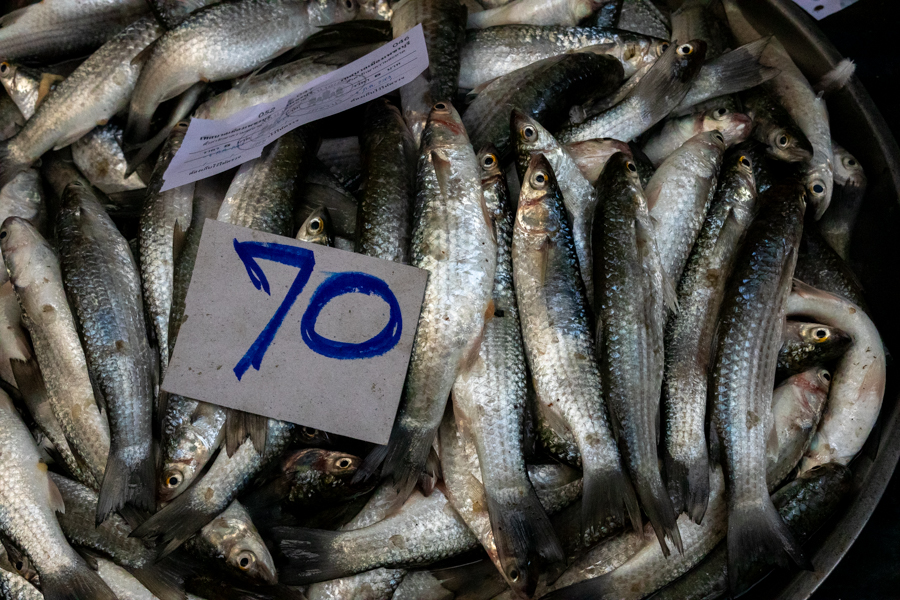
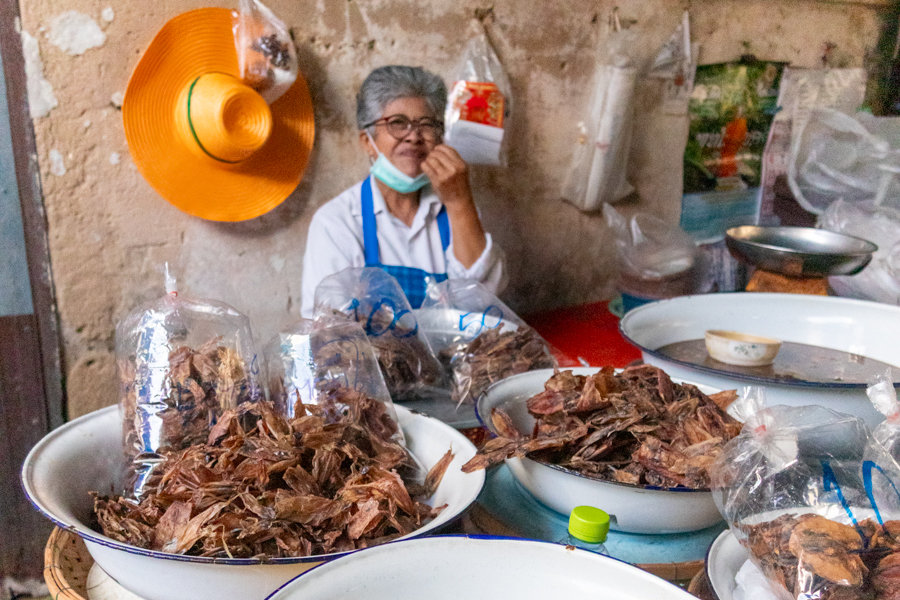
We found so many stalls lining the streets selling coffee and every type of fresh and cooked food. Many mysterious potions and soups and meatballs which we were not adventurous enough to try.
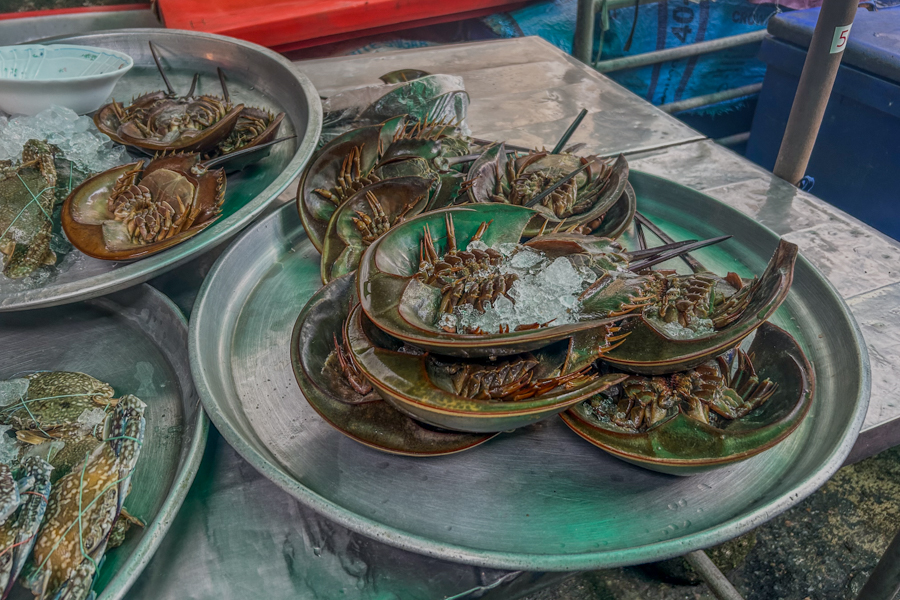
Lots of seafood including horseshoe crabs which was a bit disconcerting. They were small ones and I am sure they are endangered. We never saw cat or dog on the menu but they do eat a wide range of things.
The whole town seemed to be there doing their fresh produce shopping.

Always good to start with coffee….
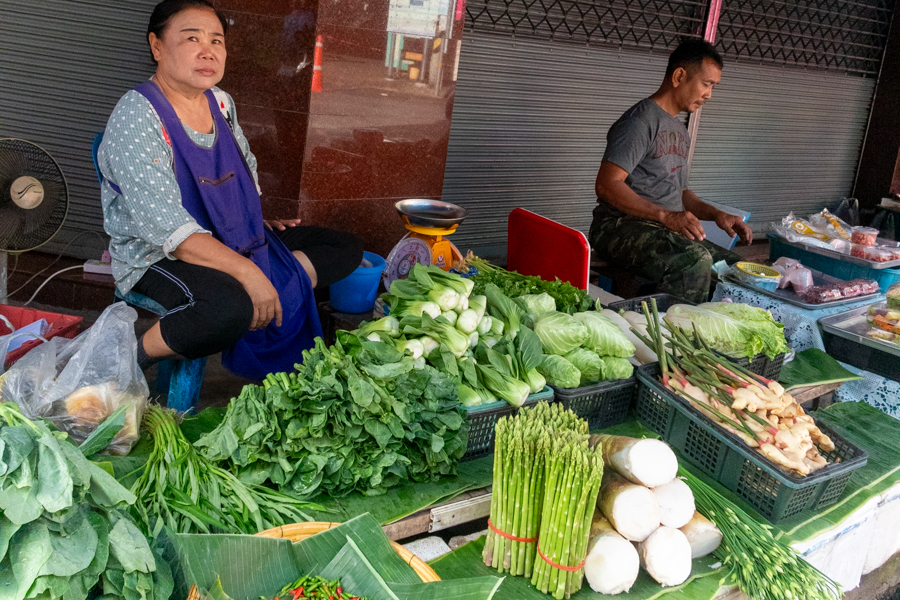
Fresh produce of all types.
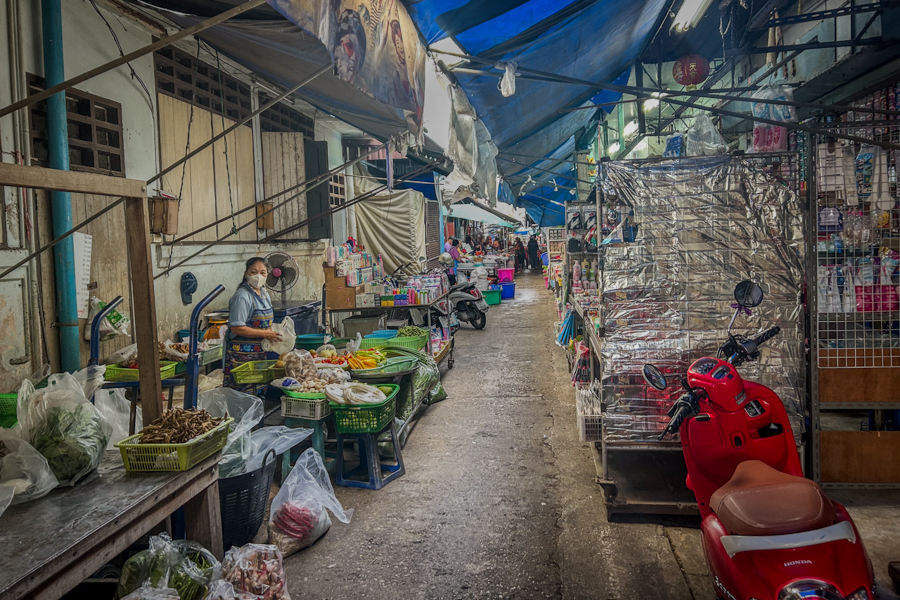
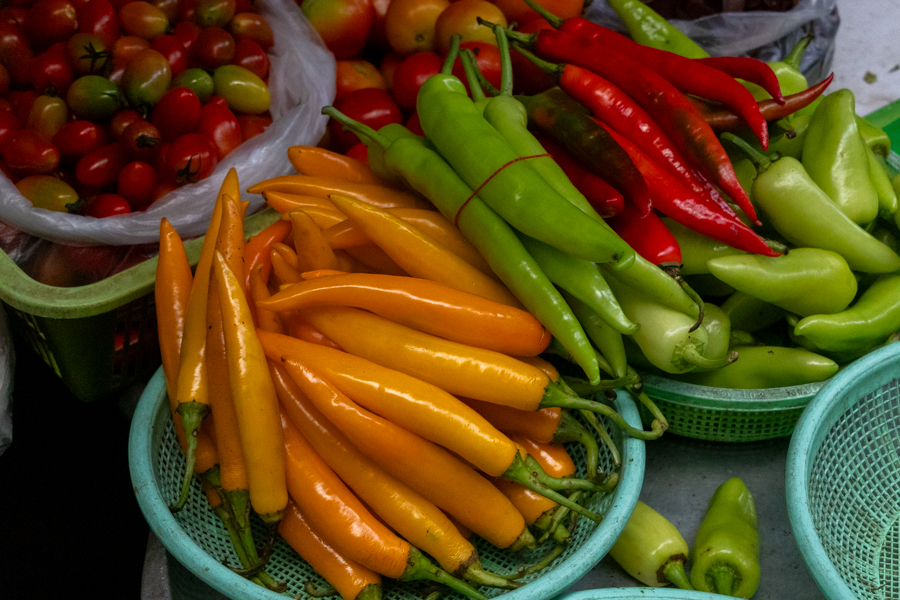
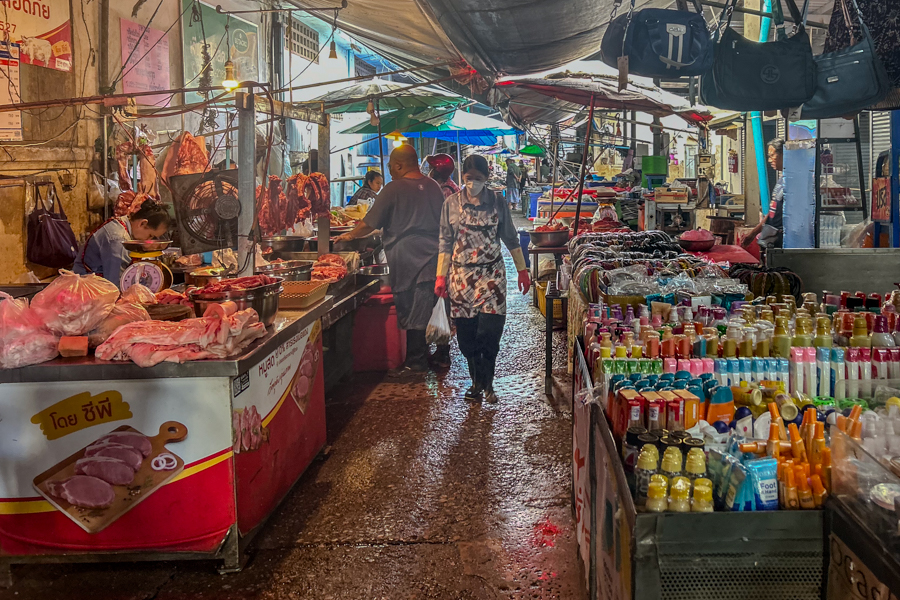
The stalls are in front of the shopfronts which, in the small winding streets, were quite dark and dingy. It looked like the families lived in some of the shops. Many of the goods looked very uninviting, old and dusty, but there were also normal stores with hardware and cosmetics and temple offerings.
A lot of places had one or 2 tables outside suggesting they may also sell food sometimes. I think they may cook for a few people at mealtimes. Everyone seems to contribute to the economy and make enough to feed the family every day.
There are no supermarkets or hypermarkets or franchises except for the 7/11 chain, and even they tend to be small stores. They do sell a mean cheese and ham toasted sandwich for when you were noodled out though. We met a New Zealand family who had traveled the whole of Japan by eating out at 7/11s. Cost effective but a bit dull perhaps.
It was chaos but after a couple of hours the market dies down and the streets return to normal shopping streets.
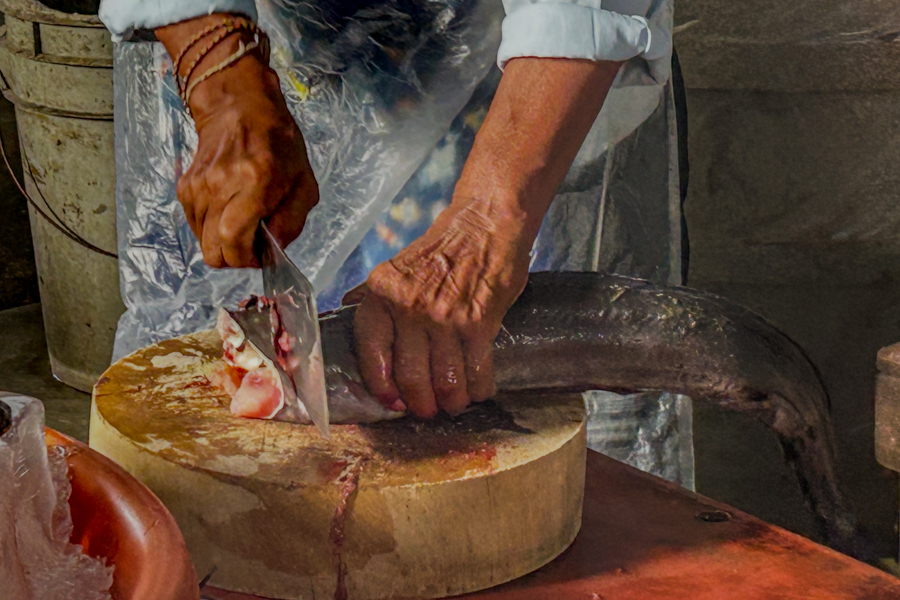
Anything from the sea is always high on the menu but I was sad to see the little horseshoe crabs.
On the Saturday we were told us we must go to the Cultural Market. They had an open air cinema showing some Thai classic opposite the temple, with face painting and kids doing mosaics and other crafts. There was food, drink and a lot of temple offerings for sale. Not a lot of alcohol though. I think the drinkers are mainly tourists.
We moved on to find the "Walking Street" market. We saw these in many towns. Once a week an area is closed off from traffic and becomes an impromptu market with food and clothes and music. It normally starts in the early evening and goes on quite late into the night.

The footbridge over the river and the local wat lit up at night.

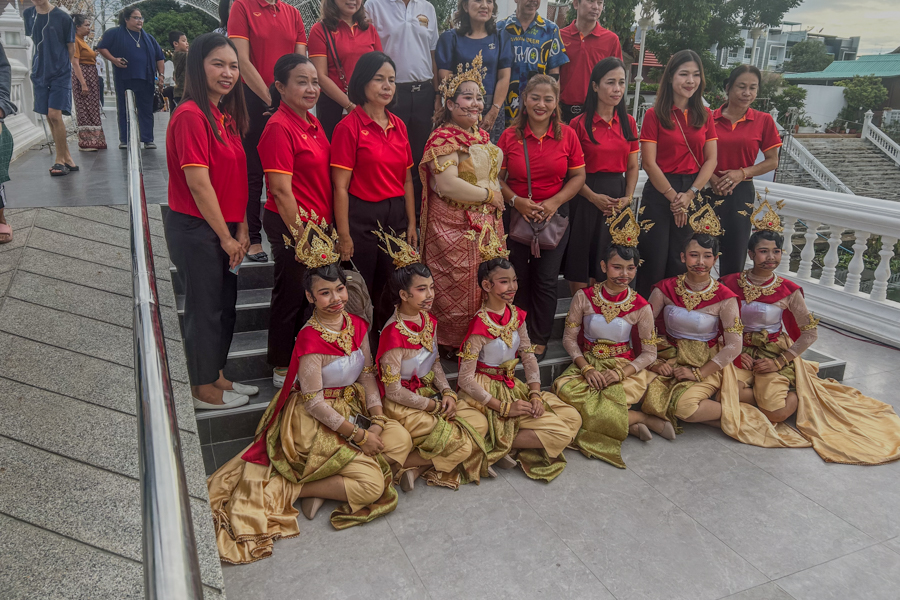
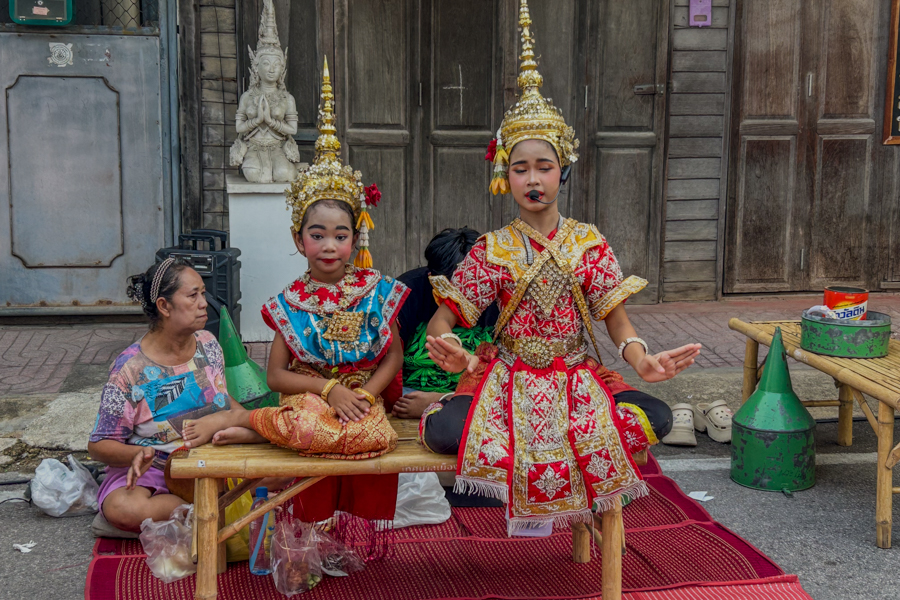
Children preparing to perform traditional dance
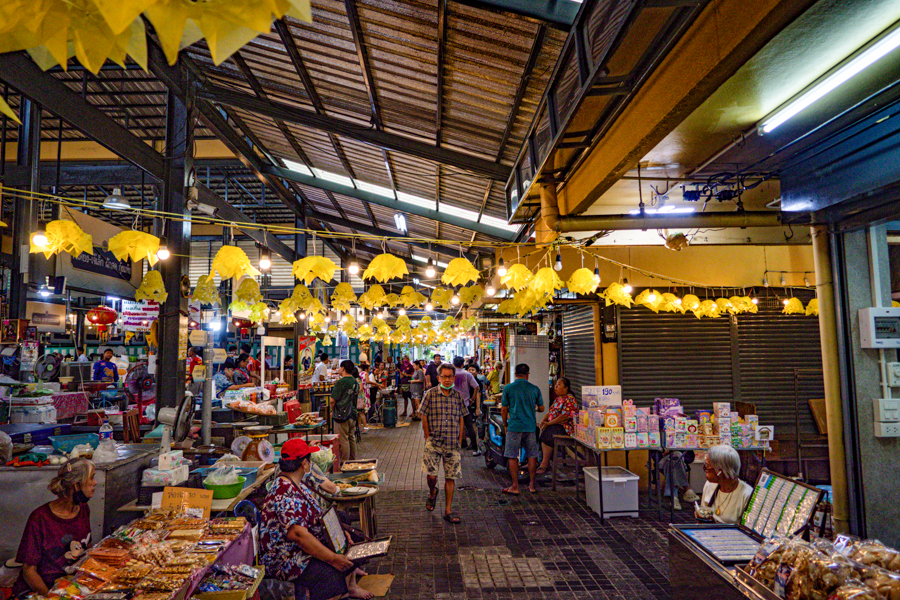
We walked over the river and headed east. After about 2 km we found the barriers across the street and the street was lined with stalls. Children in traditional Thai costume were dancing and singing. Some were playing traditional instruments. Lots of karaoke singers.
Dudley says it is child exploitation but they all seem to enjoy themselves. I gave them all coins even though some were really terrible.
There was delicious food and some interesting clothes and bags and jewellery. One stall was making pancakes but they drew quite detailed Marvel and Anime characters on the pancake using different coloured batters. I was tempted but the queue of excited kids guaranteed a long wait!
We ended at a boy band concert at the end of the road and sat and listened for a while before wending our way home and to bed.
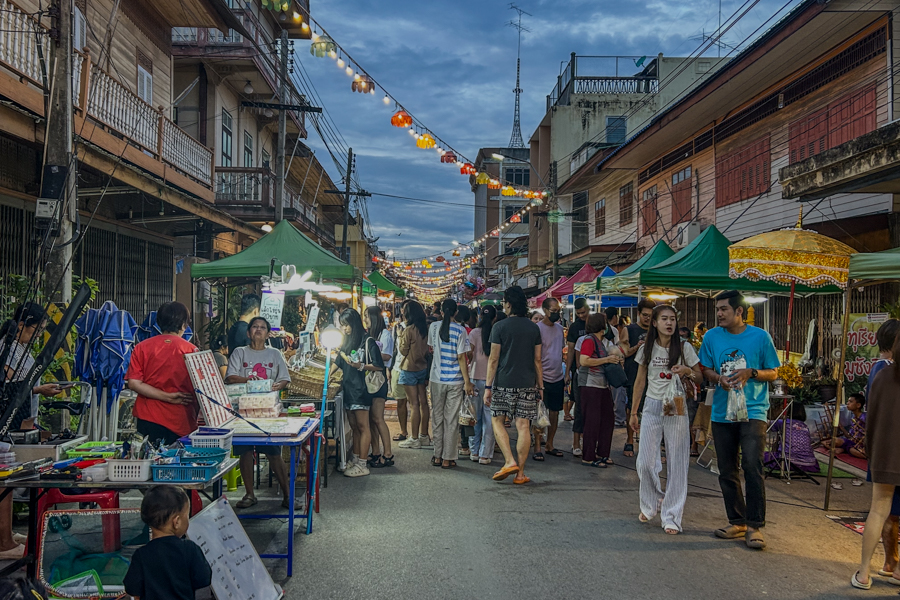
The Walking Street
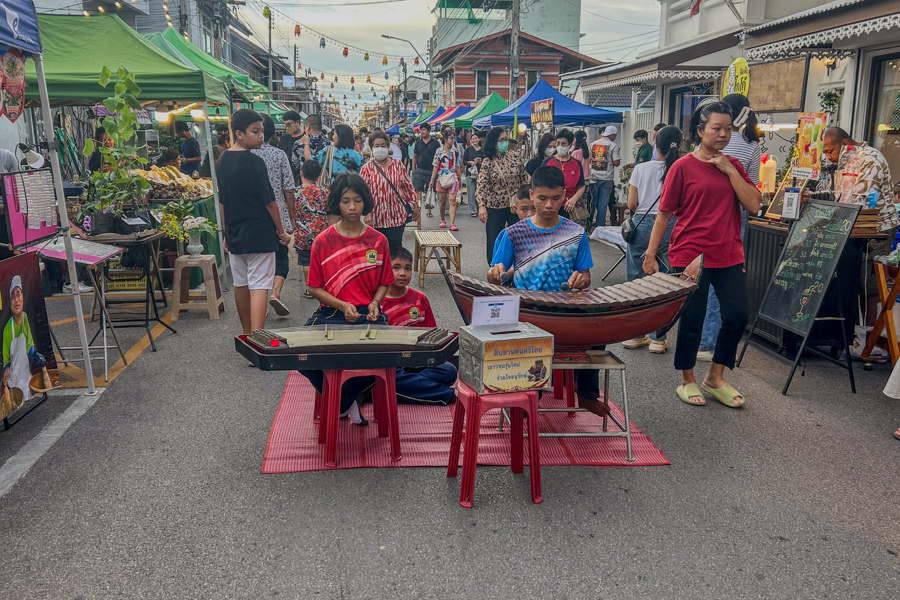
Traditional instruments and dance
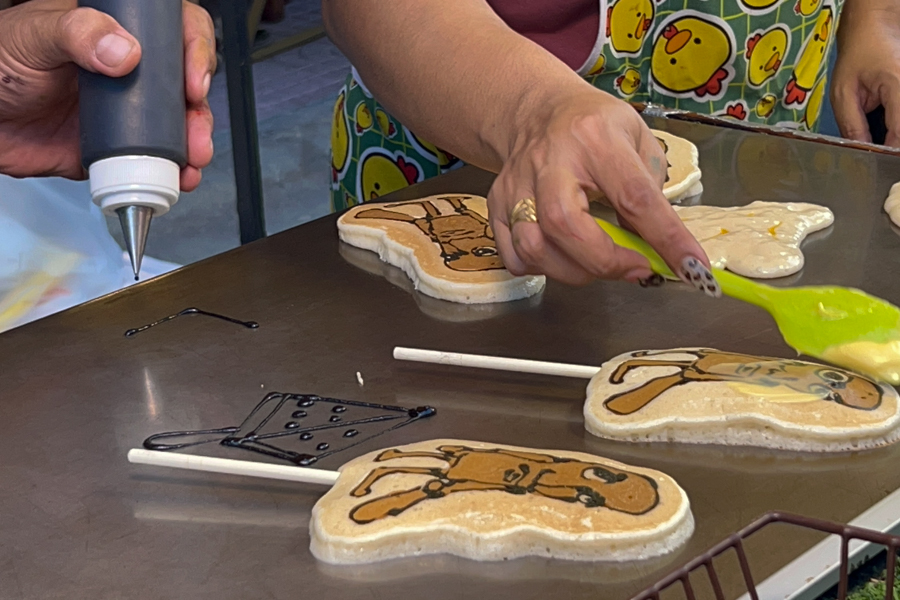
Pancakes meet art
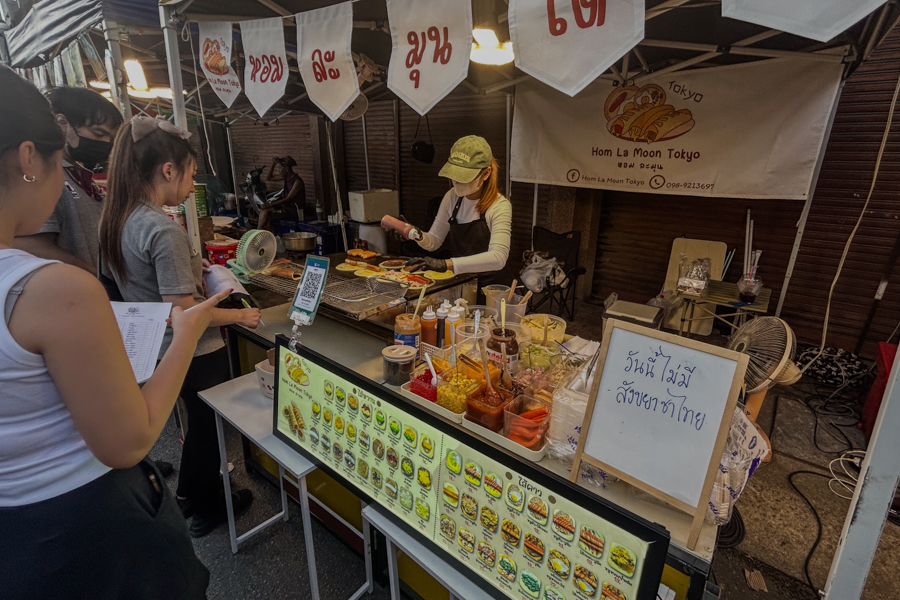
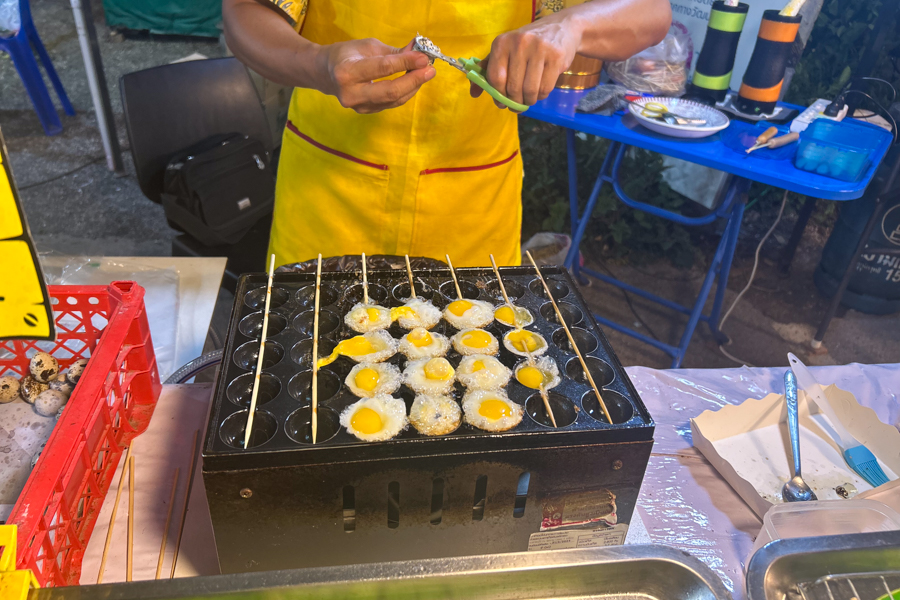
So much food of every type. Below are kebabs of quails eggs. On the way home he gave me a stick to try.
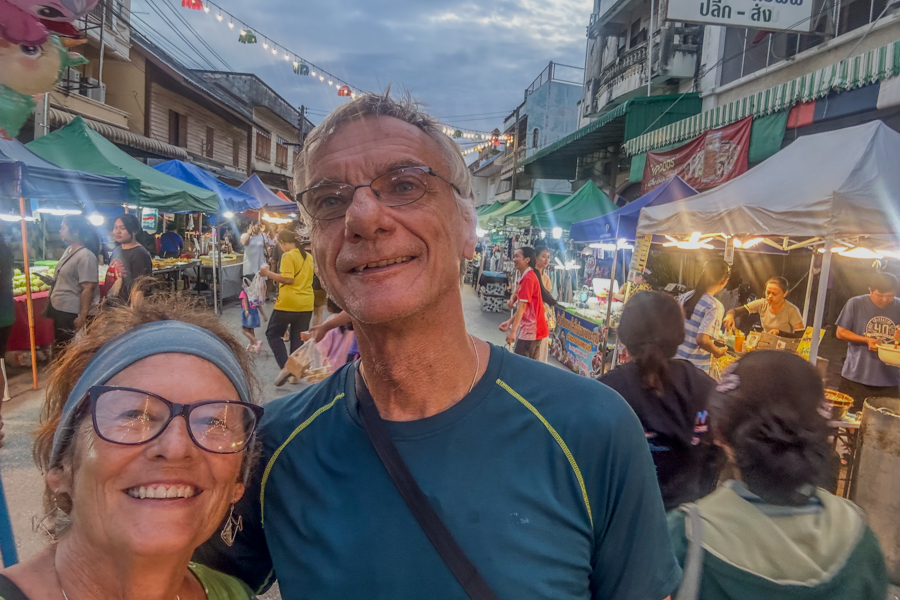
Ending with a Boy Band

Tham Khao Luang Cave


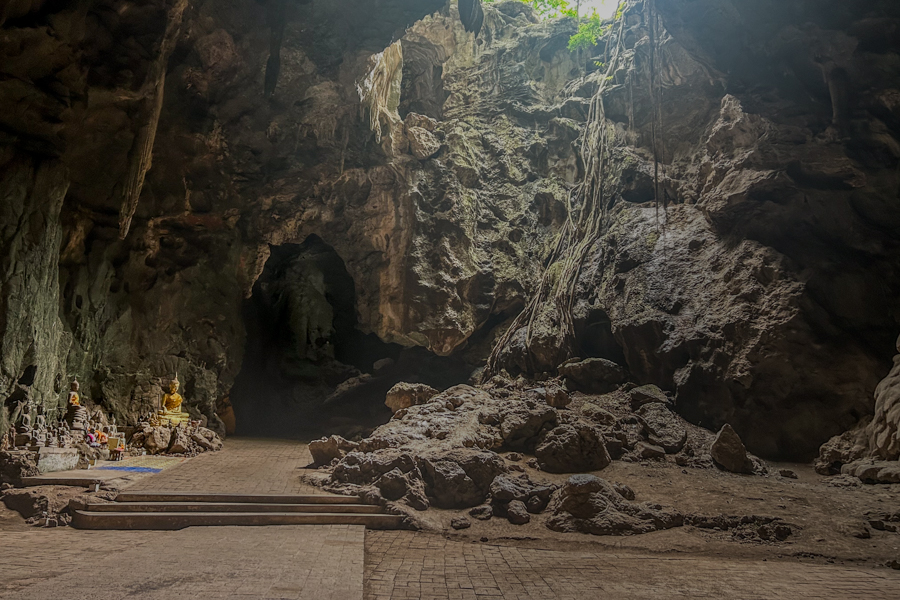

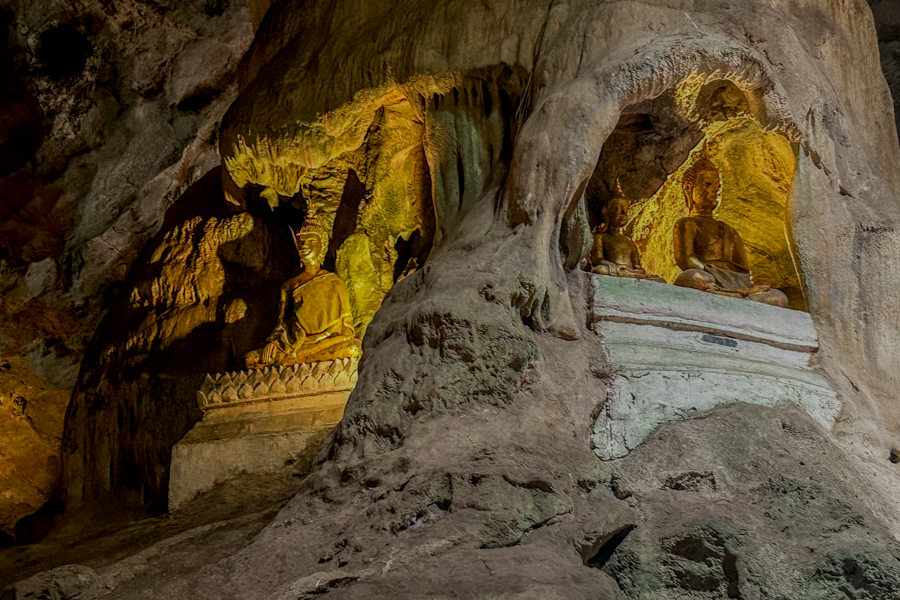
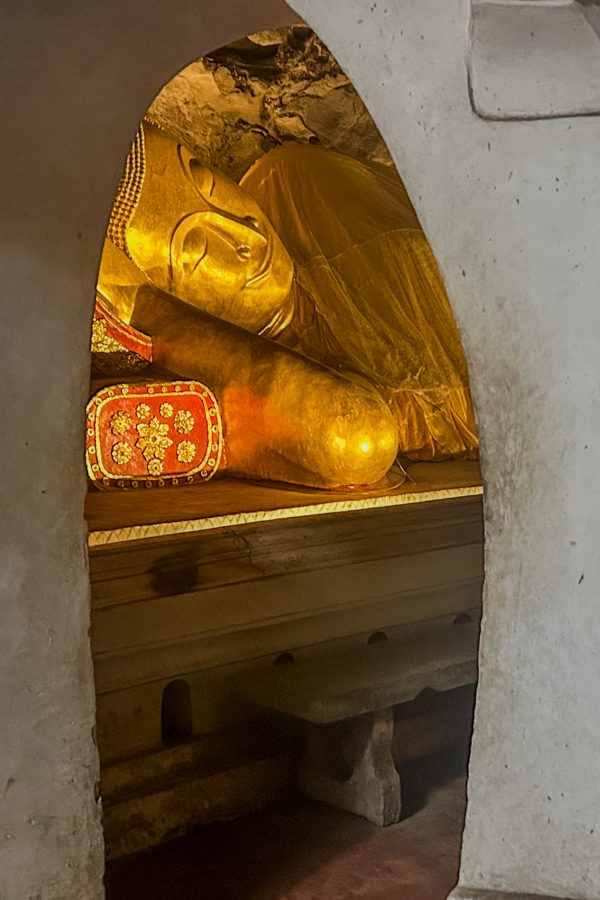


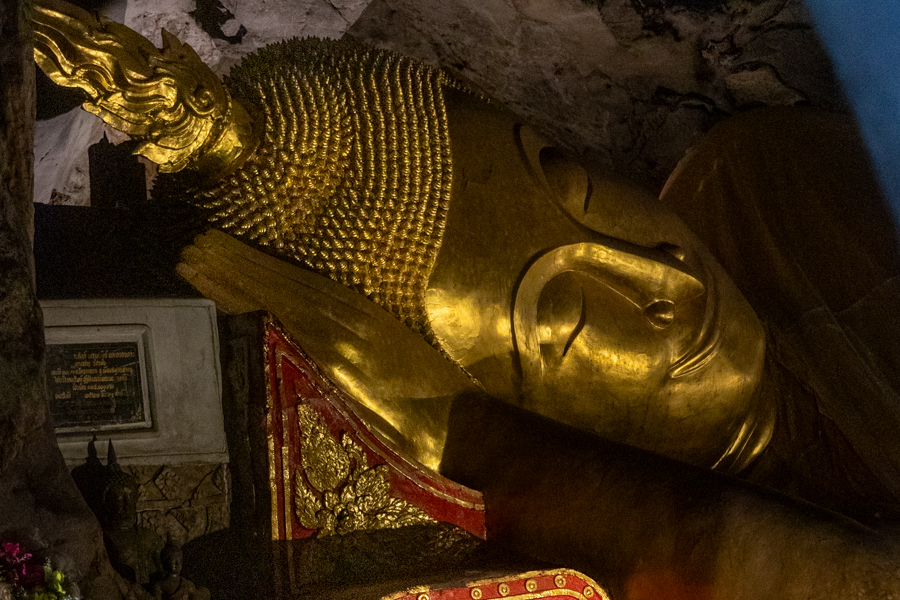
The reason we came to Phetchaburi was to see the temple in the Tham Khao Luang Cave system and so on our first full day in Phetchaburi we set off. This is perhaps the most famous of the sights of Phetchaburi, a temple in a cave just on the outskirts of town which features a huge gold reclining buddha.
We took a taxi to the cave entrance. I was still in Sam Roi Yot mode and anticipated some hectic climbing but the entrance to the cave is up a tarred road and there is a car park with a small cafe and a place to buy tickets. Much cheaper this time, a mere 10 Bht got us in.
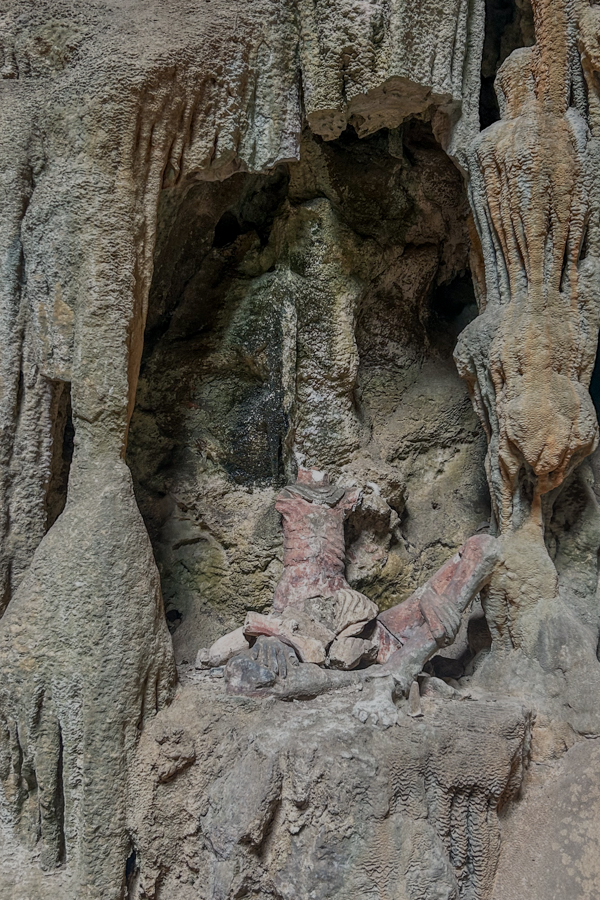
We walked up to the entrance and then down into the cave system. There are a series of 4 interlinking caverns which make up the cave system. Some of the roofs have collapsed so here and there natural light streams in. There are impressive stalactites and stalactites decorating the walls. A petrified waterfall marks the entrance to the second cave. Small bats clung to the rocky ceiling and a little old lady was brushing the bat droppings away for the day. Always the buildings and temples are kept scrupulously clean.
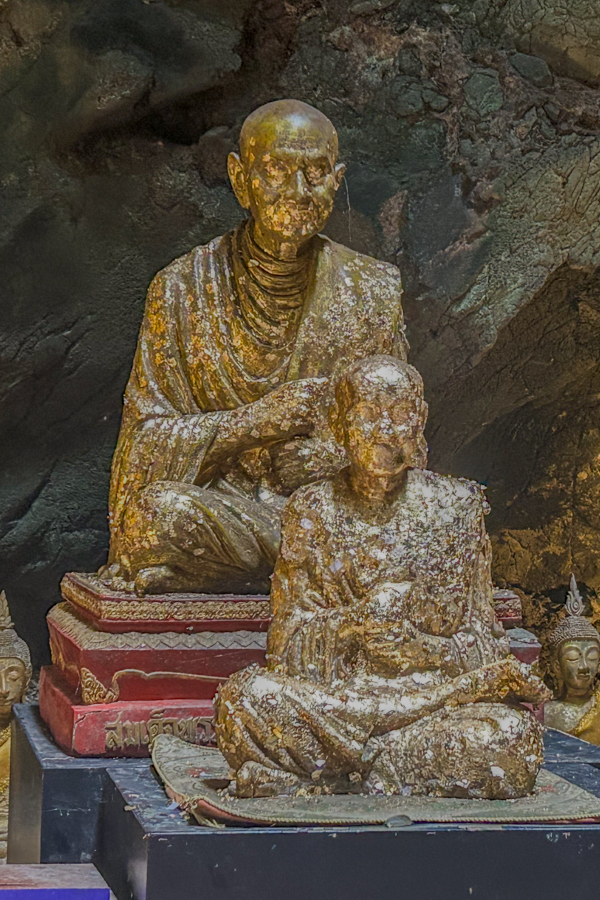
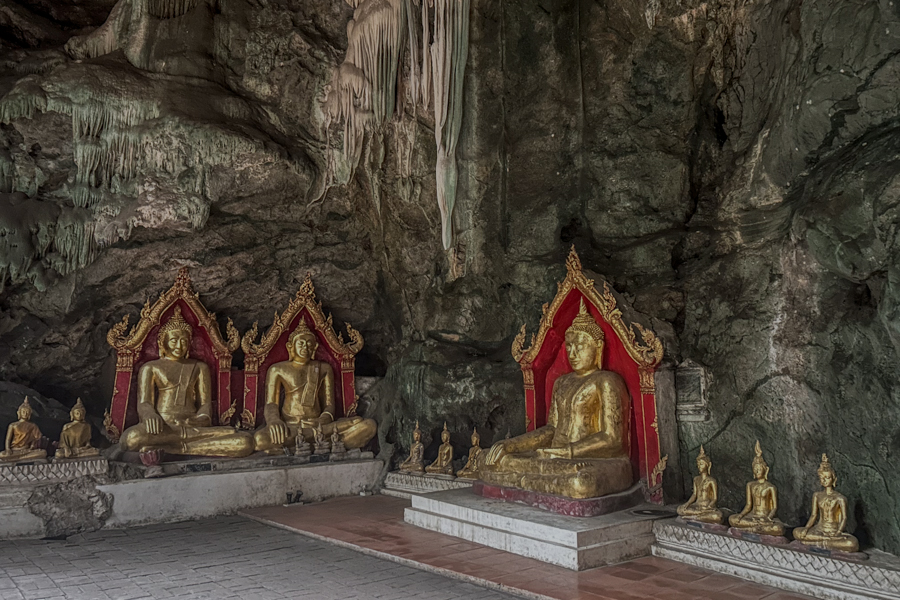
The whole cave system is filled with golden buddhas of all shapes and sizes.
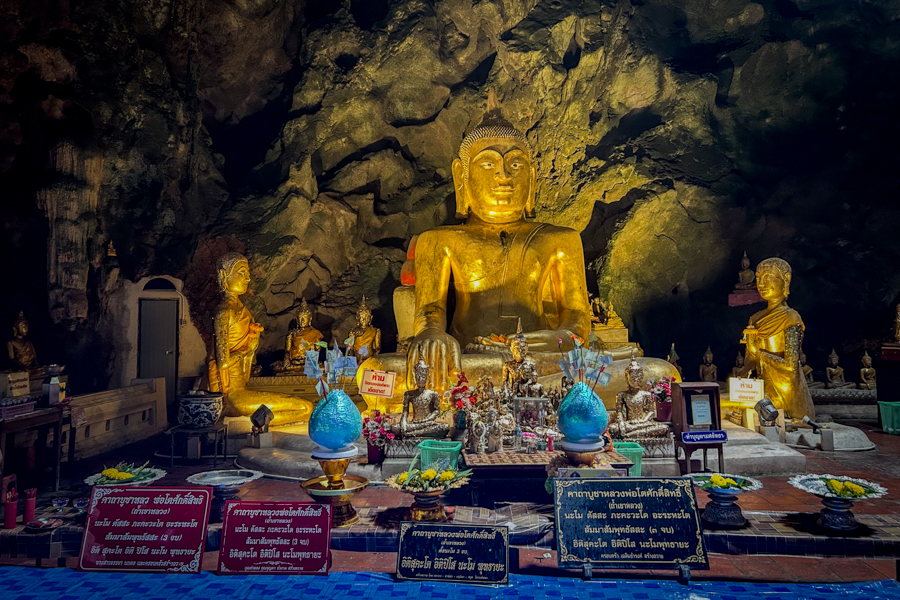
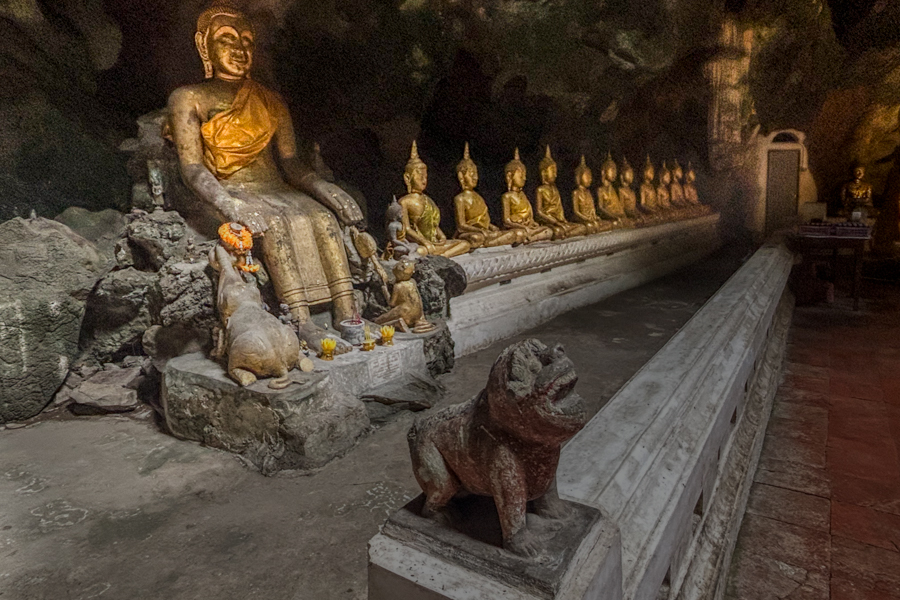
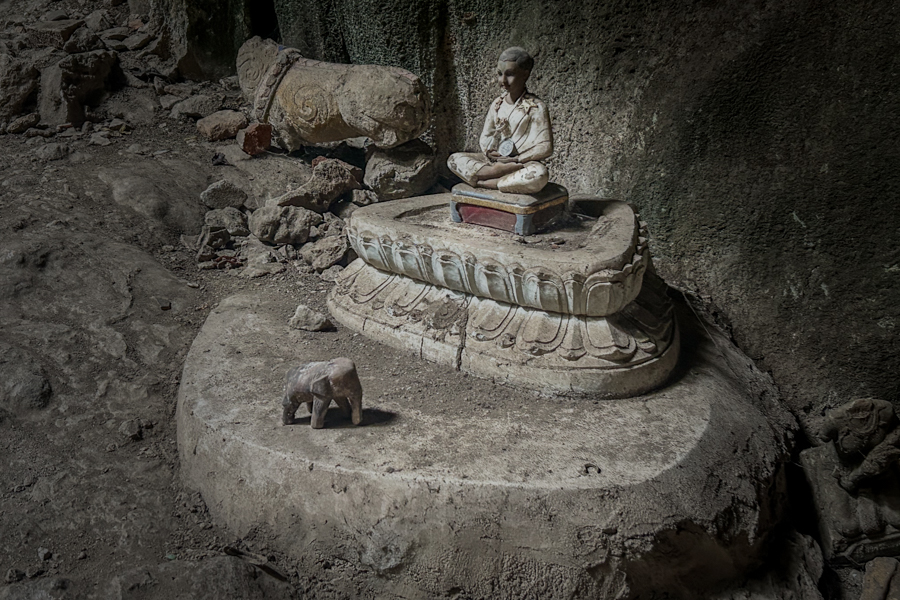
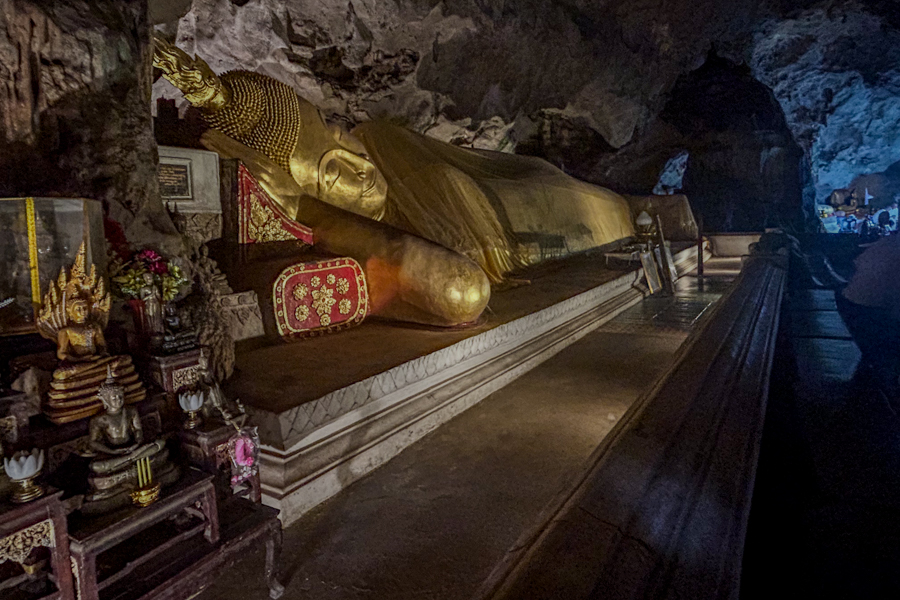
Buddhas line the walls and are tucked in every little rock recess and hole.
In the main cavern a large sitting buddha is surrounded by smaller statues and further back a huge reclining buddha can be found. There are also some statues of other Hindu gods like Vishnu and Ganesh and snakes and monkeys and elephants. Candles and joss sticks burned. A few monks in their orange robes sat or walked among the statues.
The temple was proclaimed by Rama V in honour of his father.
He had meditated in the caves as a young monk and felt the rock formations were particularly spectacular. It is now a recognised UNESCO World Heritage Site.
It was approaching midday and although overcast we had some nice light coming through the broken rock. The ideal is about 10.00 am in the early part of the year when golden rays can be found slanting into the cave and lighting up the statues. Still it was beautiful and very worth our while. There was a sense of calm and otherworldly beauty as the light glinted off the rows of buddhas.
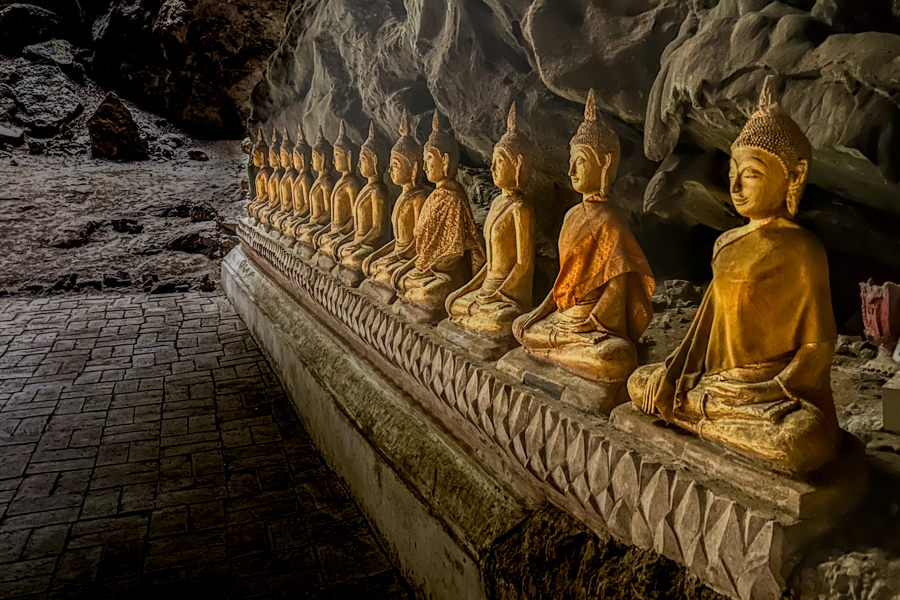

We decided to walk back, theoretically a little over 3 km. The macaque monkeys were playing in the trees next to the road.
It was hot but we strolled down the main road past shops and cafes, schools and hospitals. The difficulty walking in Thailand is that the pavements are used for everything except walking. The shops spill out onto the pavement, the scooters park on the pavement, the food stalls are parked on the pavements and throw out their tables and chairs on the pavement. The pavement is not that wide to start with but in the end you are mostly walking in the road which can be hazardous to your health.
We arrived home hot and exhausted and collapsed on the bed for the rest of the afternoon.

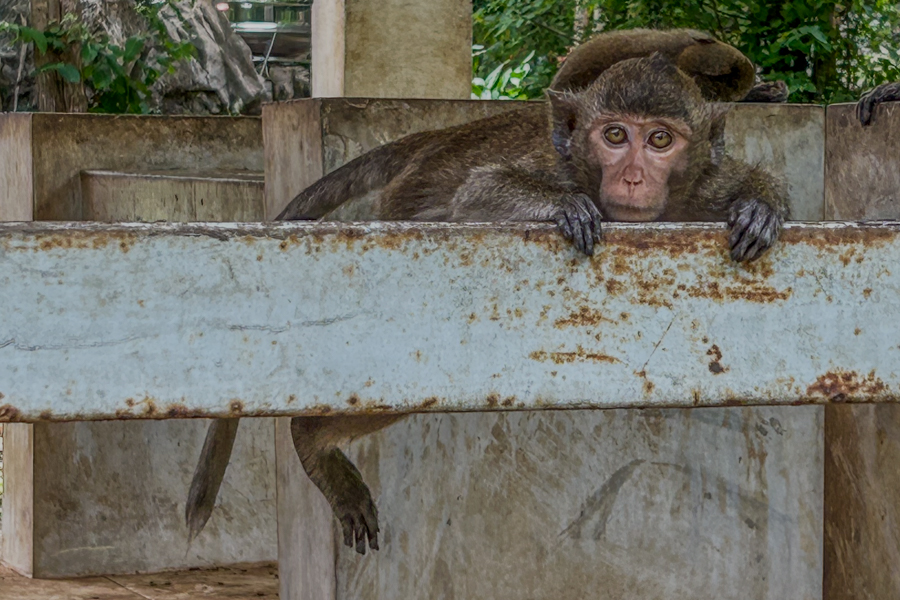
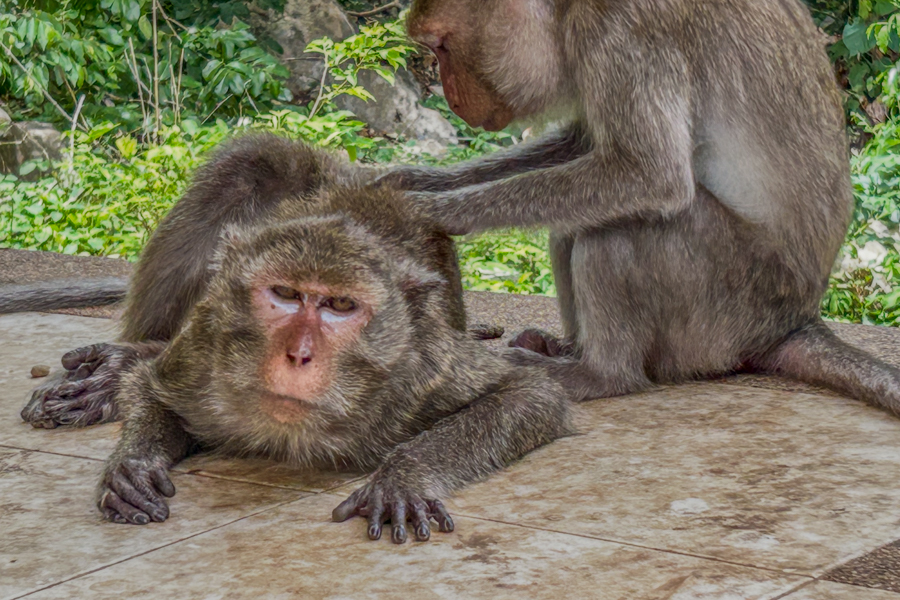
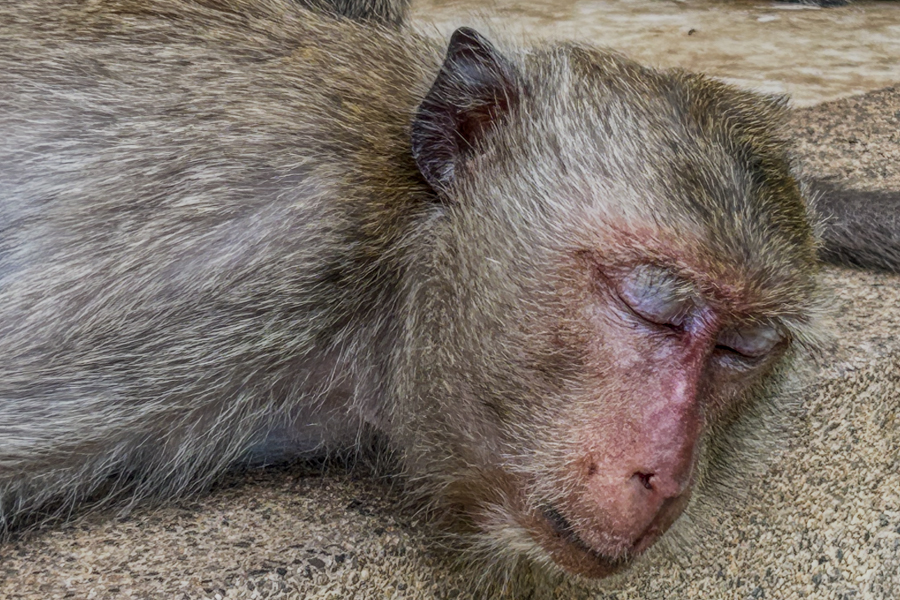
Clearly it had also been a very hard hot day in monkey land!
The King and I

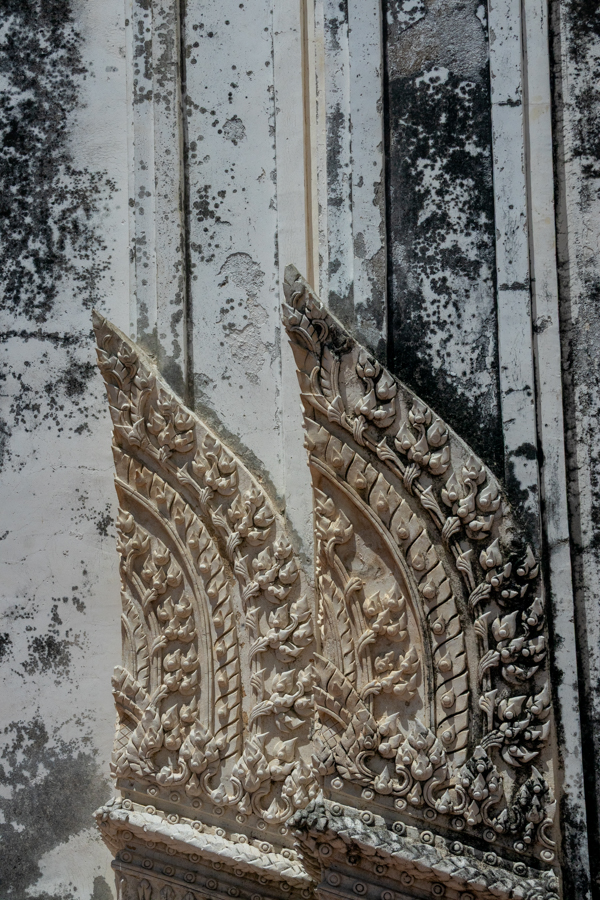
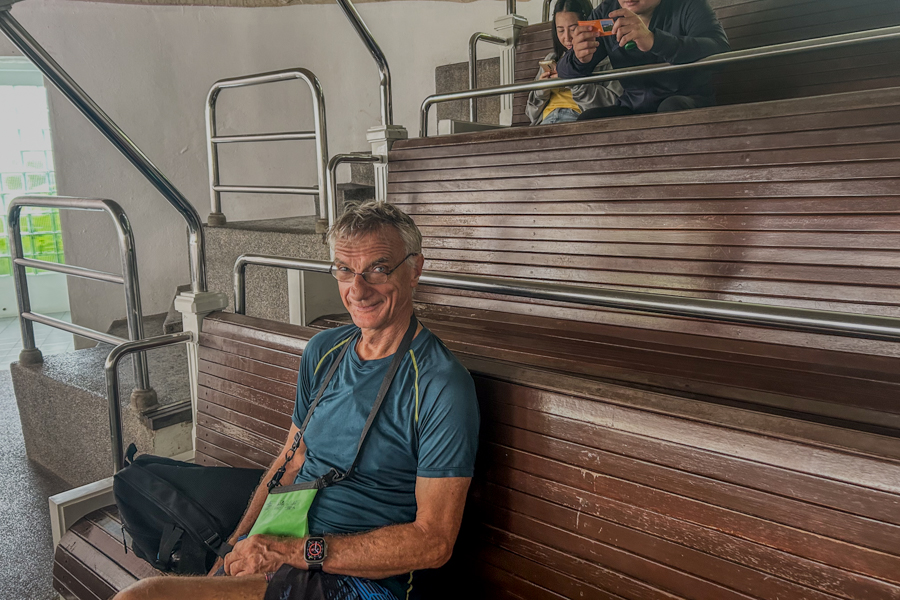
The cablecar is like a row of benches with an awning which lifts gently up to deposit you in the royal garden.


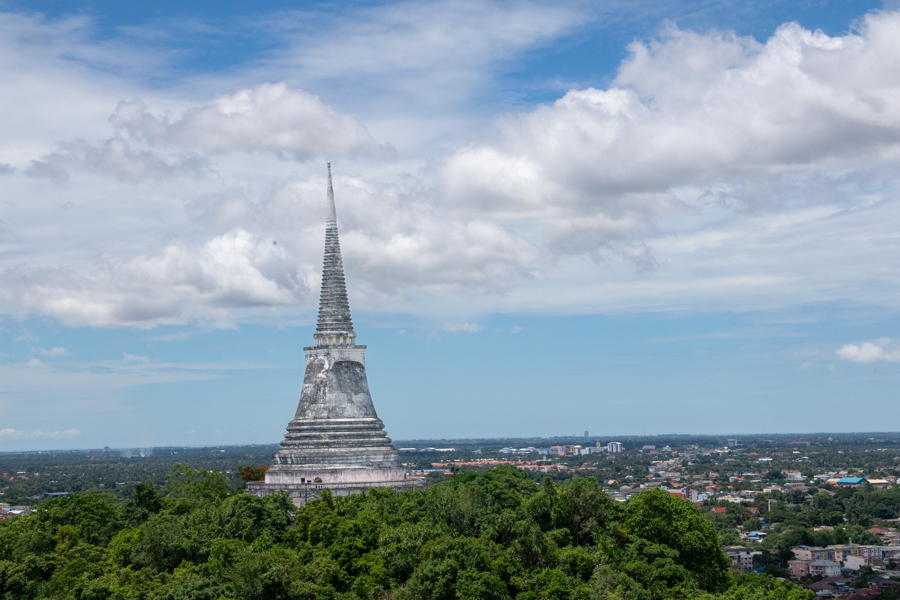
The White Chedi and 360 degree view from the top of the royal compound
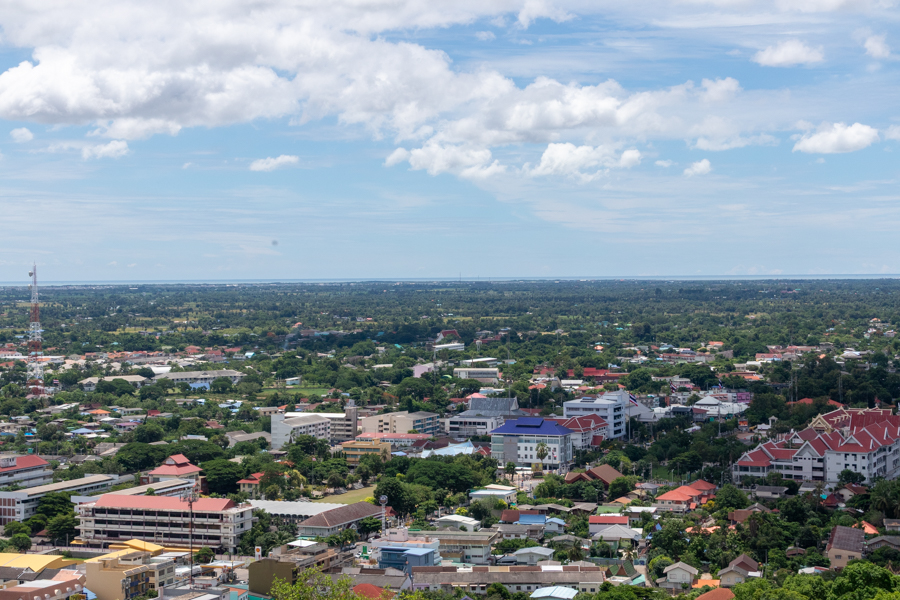
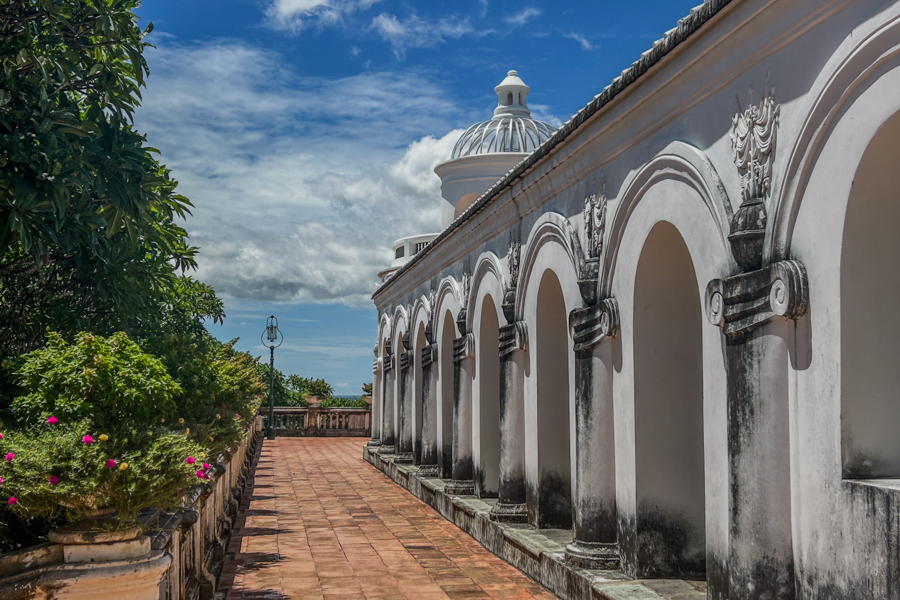
Unknown to us before we arrived, Phetchaburi is also the home of one of the Royal Palaces, Phra Nakhon Khiri, built by Rama IV, King Mongkut, one of the 'Great' kings of Thailand (They only gave the title 'Great' to 3 of the royal line) It is now a type of living museum. It is in a park on a series of 3 hills overlooking the town. You can climb up to the palace or take a cable car. We worked out it was about 3 km from our base to the cable car, and set off to walk there.
We again enjoyed strolling the streets. We stopped for coffee and dodged the pavement chaos until we arrived at the cable car set in a line of shops selling souvenirs and clothing, drinks and temple offerings.
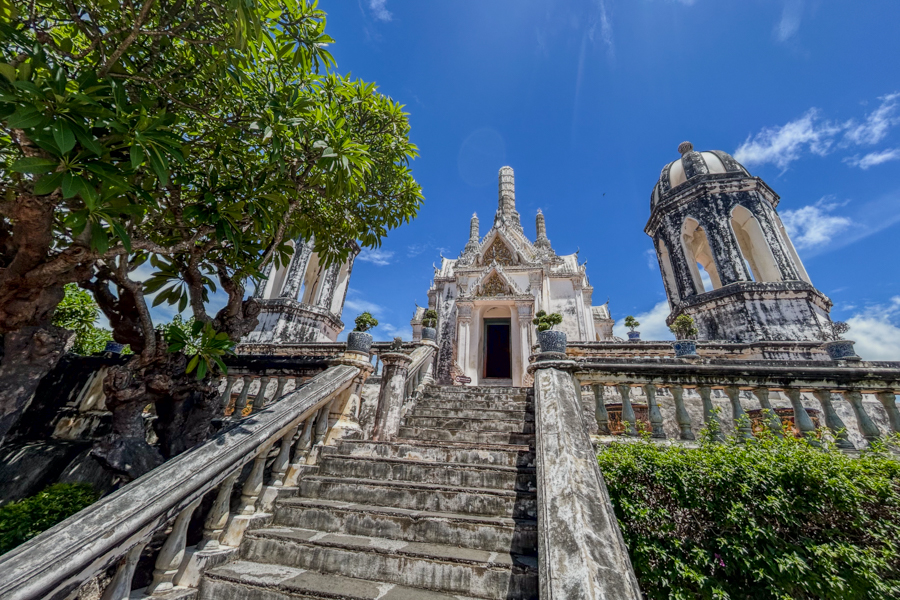
The cable car is like an open tiered carriage and it rises up through the forest to the top of the hill. The palace is set in winding gardens with shaded paths, shrines and lookouts. The royal temple and a huge white Chedi with a 360 degree view complete the complex. I think the position on the hill is cooler and that it was used as a summer retreat by King Mongkut and his son Rama V, King Chulalongkorn.
The palace itself has been left fully furnished and, if appropriately dressed, you can walk through the rooms. You leave your shoes at the door and each room has a guard to prevent photography. I am not sure why, The royal family is treated with great deference.

Everywhere you go in Thailand there are posters of the royal family, many of them life-sized or larger. On buildings and roads and bridges. You could never claim you did not know Thailand has a king because he is everywhere. The present incumbent is Rama X.
Thailand has the strictest and most far reaching laws covering lese majesty in the world. Essentially if you speak ill of the king, or any of the royal family, you can be thrown in jail. Before the coup which terminated the absolute monarchy in the 1930's (it's now a constitutional monarchy) these laws even covered any insult to the family pets or any defacement of images of the king. You could be jailed for insulting the kings dog or stepping on a coin or note, all of which bear his image. If your money is blowing away let it go. As a deterrent it definitely discourages criticism and most of the Thai people we met would not speak of the king at all, which suggests these punishments are not just historical but remain a real threat.
Anyway it means everyone is hyper respectful of the royal family. Is it respect when it is grounded in intimidation? We had to behave ourselves and Dudley pulled his long pants out of the rucksack. They were crumpled and a bit dirty but at least they covered his legs.


To add context to this story King Mongkut was the king on whom the famous musical The King and I was based with Yul Bryner. It was banned in Thailand because it was felt to be disrespectful. He was, and is, a highly venerated king. At the time he ascended to the throne he had been a monk for many years. He is viewed as a very wise and pious man.
The musical is based on the memoirs of Anne Leonowens who was indeed governess to King Mongkuts children, but even Hollywood admits to taking some liberties with the truth in the adaptation.
I think the main problem is in depicting the king and Anna's sexual tension, and also having him sing and dance, unlikely frivolity, especially as he seems to have been one of the more morally upright figures in Thai history. He was, however, progressive, a great ruler, and a driving force in keeping Thailand independent. He knew that he needed to learn the ways of the Europeans to navigate the tricky politics of the time. Hence the English governess. He was clever and diplomatic and between him and his son, Chulalongkorn, they navigated Thailand through the colonial threat much more successfully than their neighbours.

The house was airy and spacious with beautifully carved hardwood furniture and statues. We roamed around all the rooms and finally found ourselves back in the garden. The pathways were edged with bonsais and bougainvillea. Old gnarly frangipani trees lined the route and there were bowls of water filled with lotus flowers. Lots of butterflies. At the end of the garden is the kings observatory. He was clearly an educated and scientifically curious man.

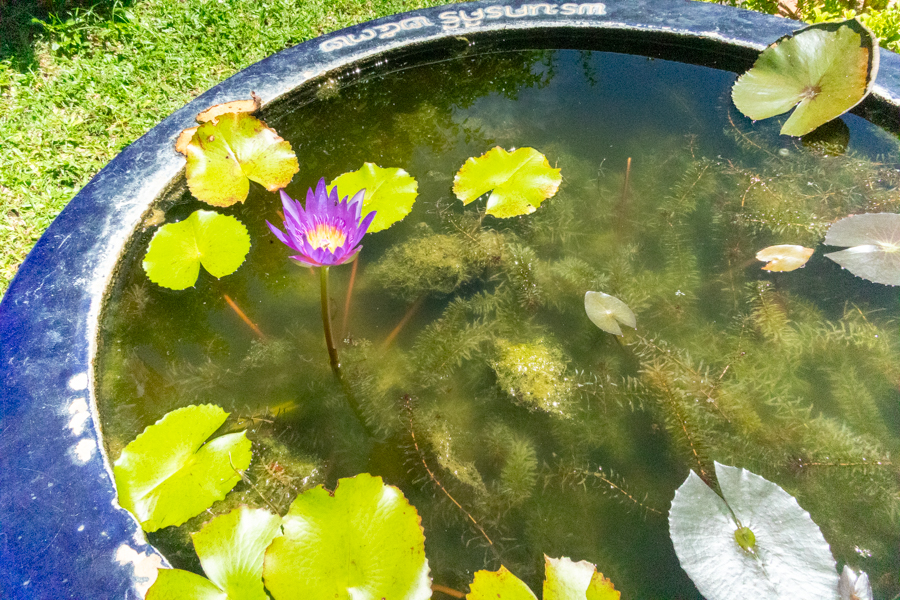

It was getting hot now so after a welcome cool drink and another wander along the paths we headed down for the long walk home.
As we walked down the road a very fancy car pulled up beside us. It was a little Thai family we had met in the garden. They could see from my bright red face that all was not well. They picked us up and whisked us back to our hostel. More random kindness.
Old Phetchaburi

View of the river from the hostel

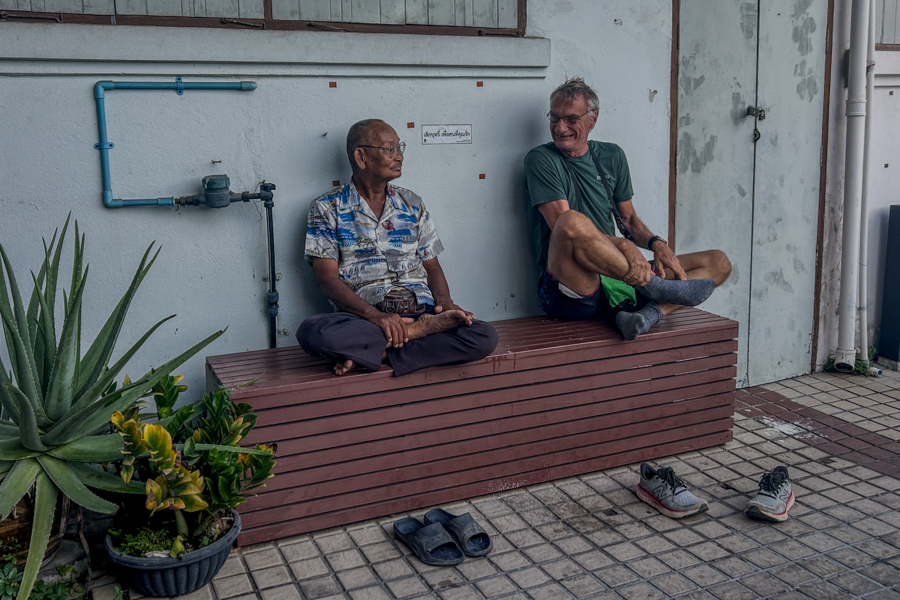
Dudley practicing his lotus position with an old gentleman who sat there on a street bench effortlessly!

Phetchaburi is an ancient city. It has been continuously inhabited since the 8th century. The backbone of the old city is the Phetchaburi river which flows out to the Bay of Bangkok.
We were lucky to be sleeping right on the river. APlus had a little gate at the end of the garden which led down to the river edge. Everyday fishermen crouched on the banks of the river fishing and children played and swam.
We loved the old city and spent happy hours just walking the small and winding streets and admiring the old buildings and bridges.
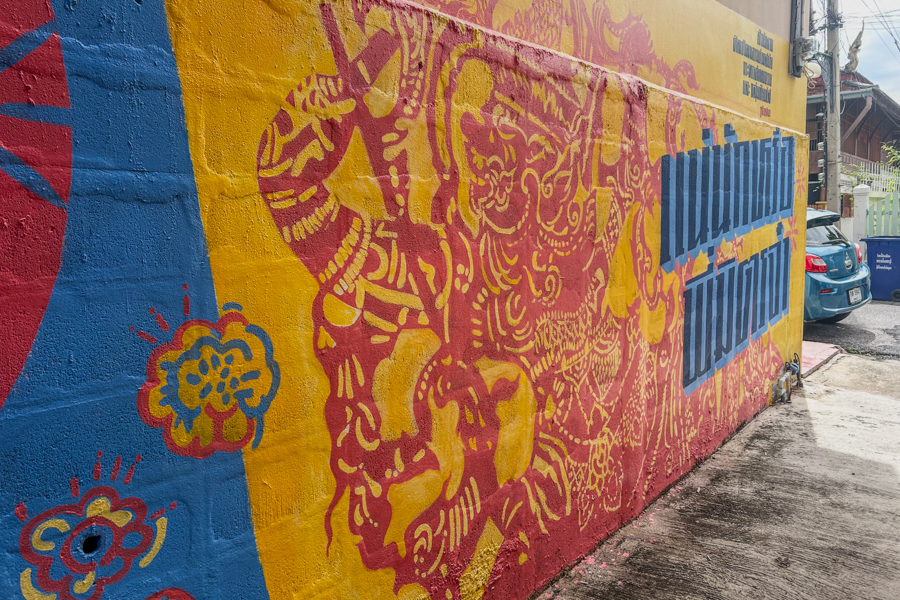
We particularly admired the prolific street art. It was colourful and eclectic, scenes of daily life mixed with cartoon characters.
Perhaps because of its age, there are also a wealth of temples here, some of them very old indeed, and we investigated some of these on our personal journey of enlightenment.
So enchanted were we with the Thai spirit, generosity and kindness, indeed their overall positivity, we wanted to understand the role of Buddhism in daily Thai life.
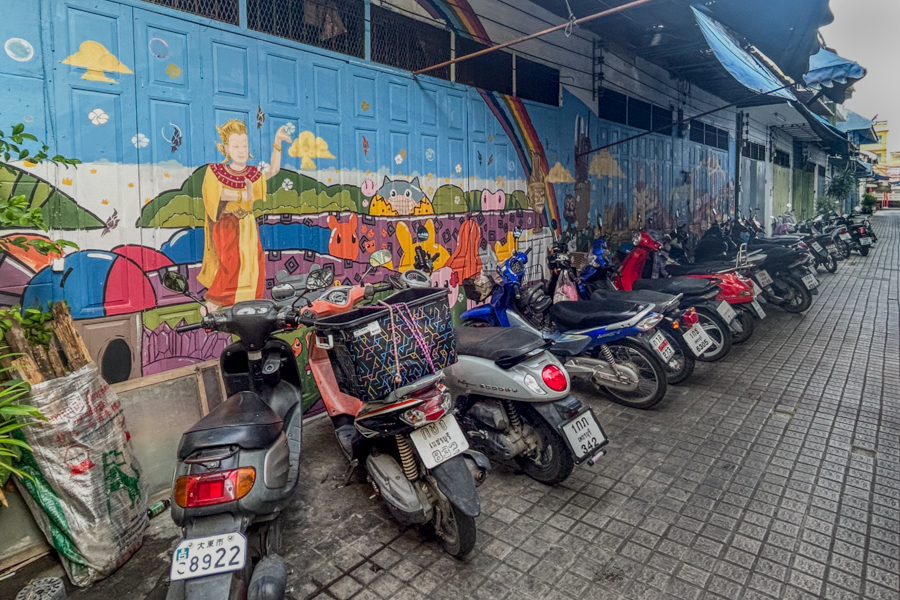


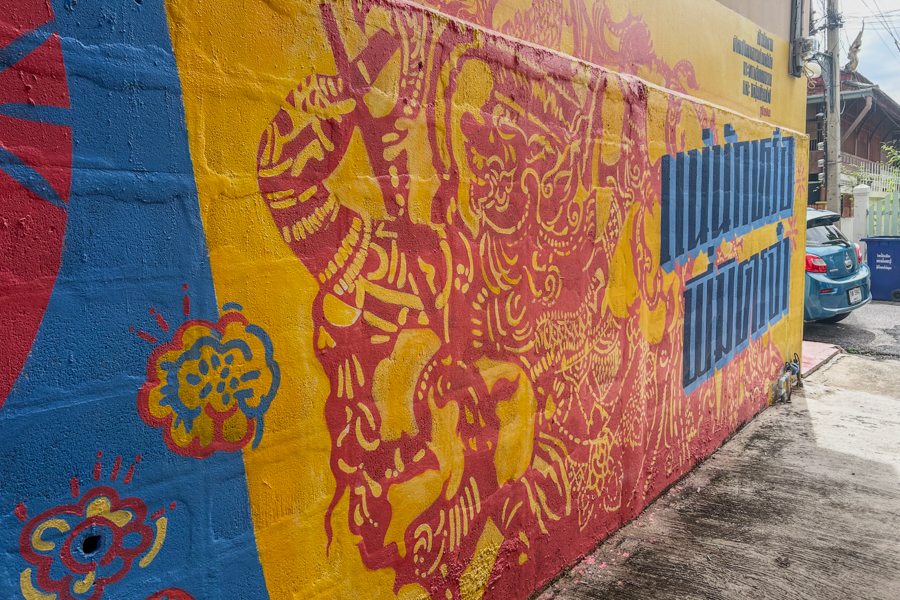

Eclectic coffee shops provide respite from the heat and chaos of the streets
We chose an old temple first, Wat Yai Suwanneram. It sat in a rather chaotic compound with a small school disgorging excited students, and a courtyard full of stalls selling temple offerings, food and flowers. We were marked as targets as we entered and were suckered into decorating a sort of multi forked stick with banknotes. We tried to buy a bag of peanut biscuits and ended up with a sackful as every time we asked how much we owed the little old lady gave us another bag.
This temple was built at the beginning of the Ayutthaya period but much of it was under renovation. As we wandered around the temple we found a big square lake with a very old little wooden house in the middle. This is apparently the Scripture House where all the texts are kept. Easy to defend perhaps, or safe from fire. The main working temple is classical Thai architecture and was surrounded by a covered cloister decorated with a solid row of golden buddhas. Inside the temple people were praying. One small family brought several water melons to lay at the feet of the Buddha before lighting joss sticks to burn in a brass bowl. They saw us watching self-consciously and asked if we wished to join them but we politely declined. I was touched by the generosity and inclusivity of his offer but did not wish to disrespect his faith. Everything is done so gently and with so much grace. We felt like 2 elephants in a room full of cats.

Wat Yai Suwanneram
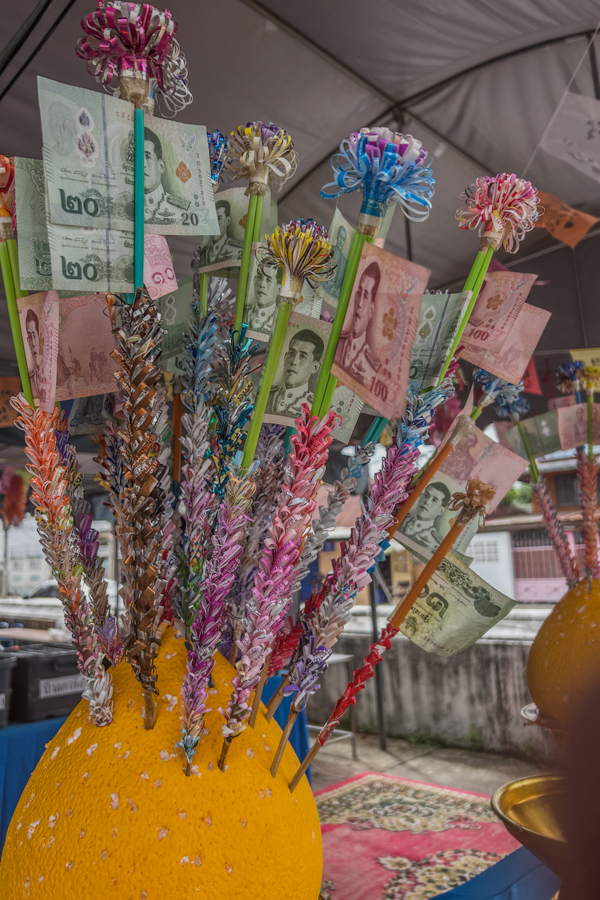

The Scripture House

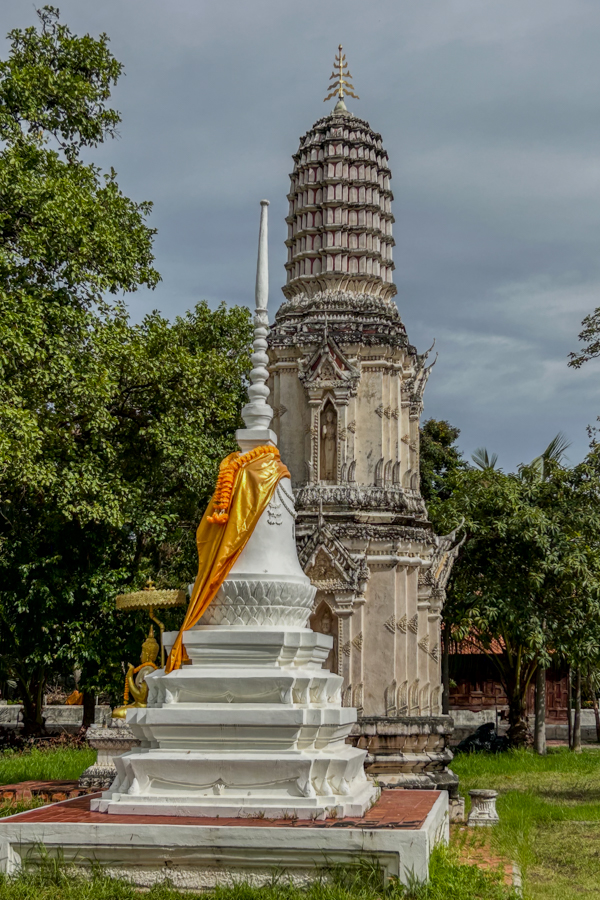
Stupas lined the gardens, we think they are the burial places for previous monks.

A covered courtyard around the viharn was lined with Buddhas. Bells and gongs are available to ring for good luck.

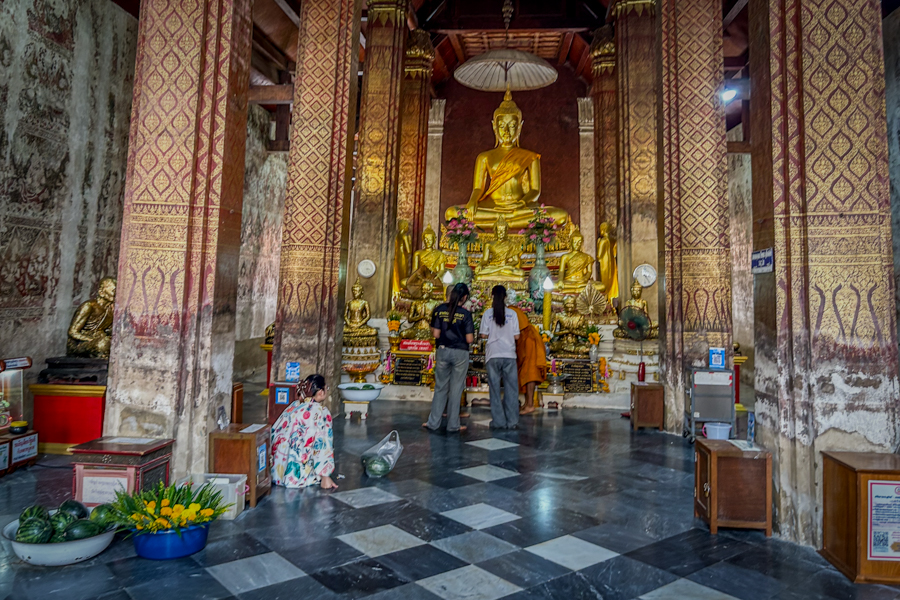
Our friendly little family bringing watermelons.
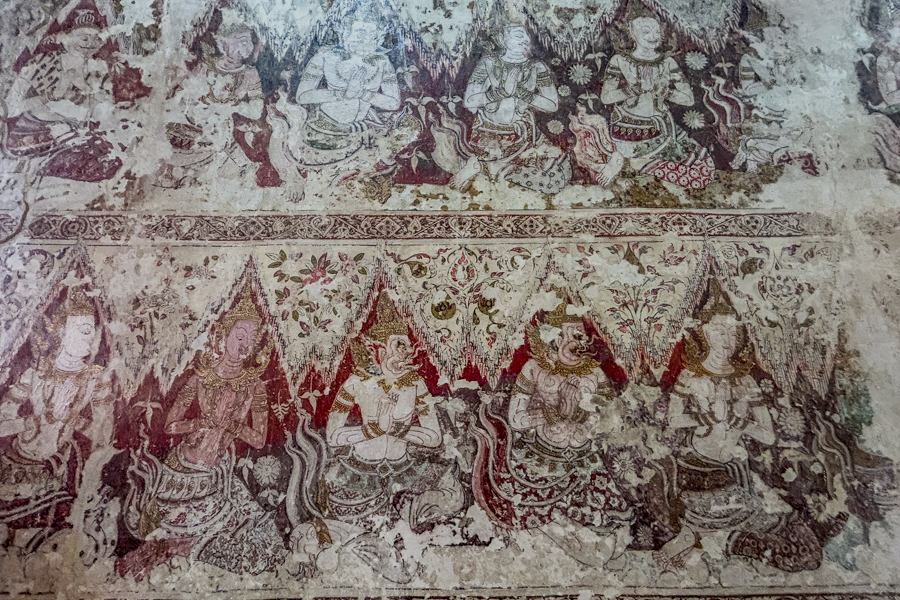
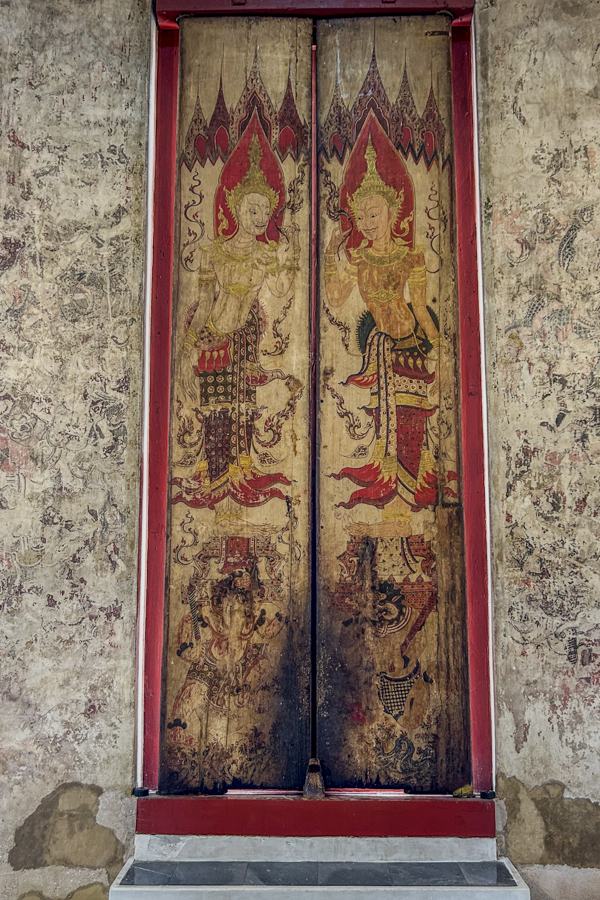
Faded frescos lined the walls.
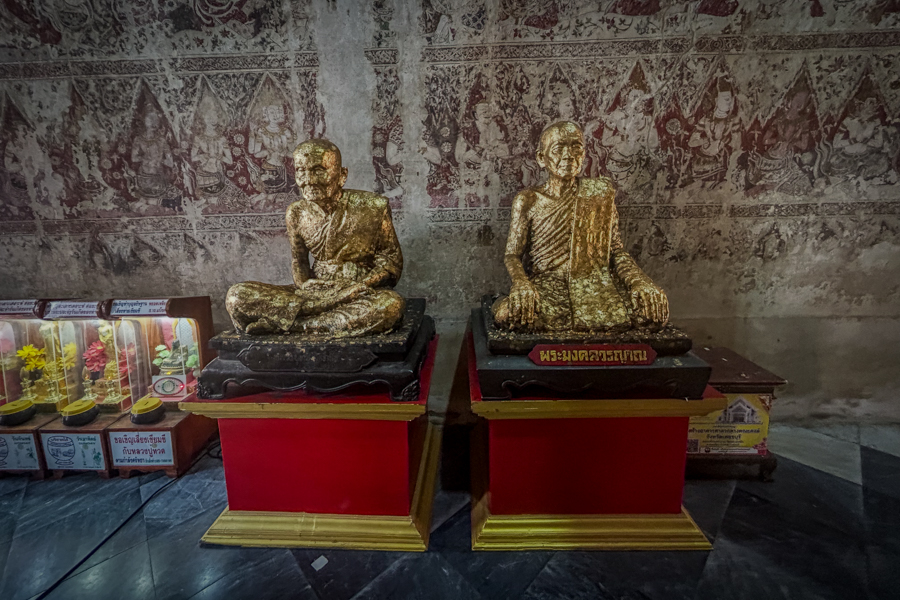
Our next temple was one of the largest in town, just up the road from us, Wat Mahathat Worawihan known for its towering white Khmer style 42m prang or tower. It has been built and rebuilt over many periods so the architecture is blended. It is a royal temple and has buddha relics and it also houses Phetchaburi's most revered buddha statue, Luang Po Wat Mahathat.
We arrived on a busy afternoon and there were people streaming in with offerings and a brisk business in flowers and joss sticks in the courtyard. Inside there were a lot of boxes labelled for special donations, food, monks, children etc. Monks were sitting around the edge offering prayers to those who asked.
Although it was crowded people come in, pray and leave quite briskly, no unnecessary hanging around. It's an important part of life but you don't need to make a song and dance about it. It was busy because it was approaching the start of the rainy season and people buy candles and supplies for the monks for this time.
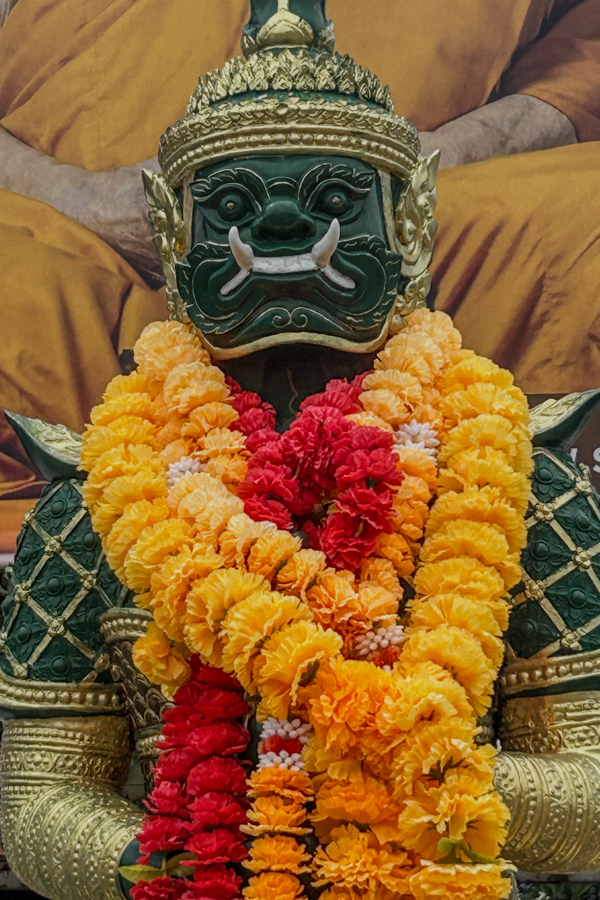
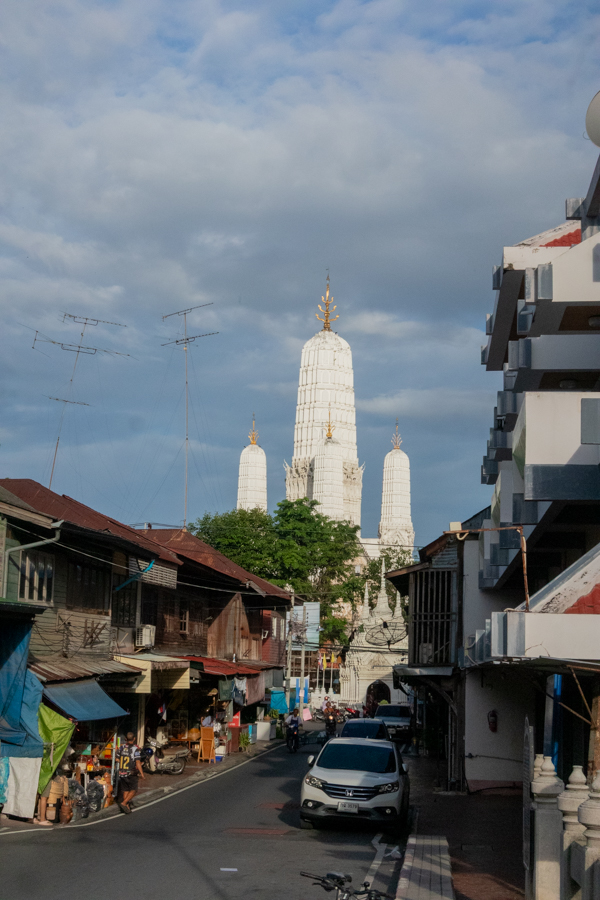

Wat Mahathat Worawihan with its bright white prangs could be recognised from far. Our cameras died as we got closer so documentation was a bit patchy!

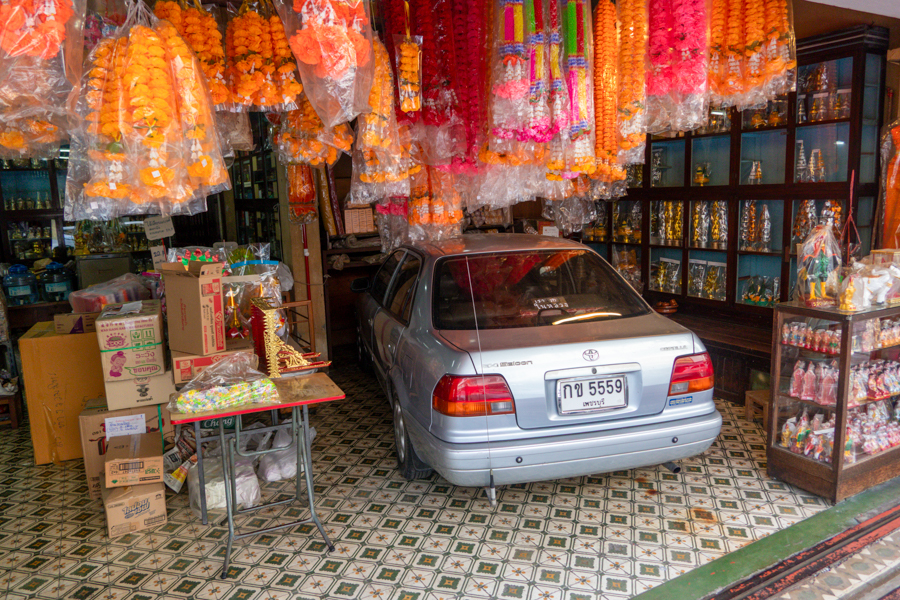
Outside the temples are shops specialising in temple offerings, flower chains, candles, joss sticks. Apparently it is also a good place to park the car.
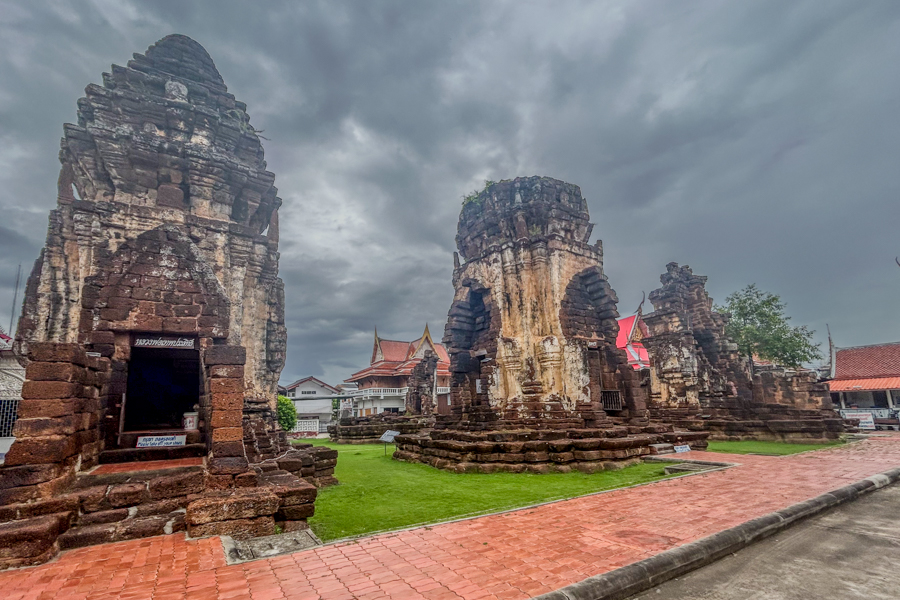
Wat Kamphaeng Laeng, the oldest temple with Kymer style corncob prangs
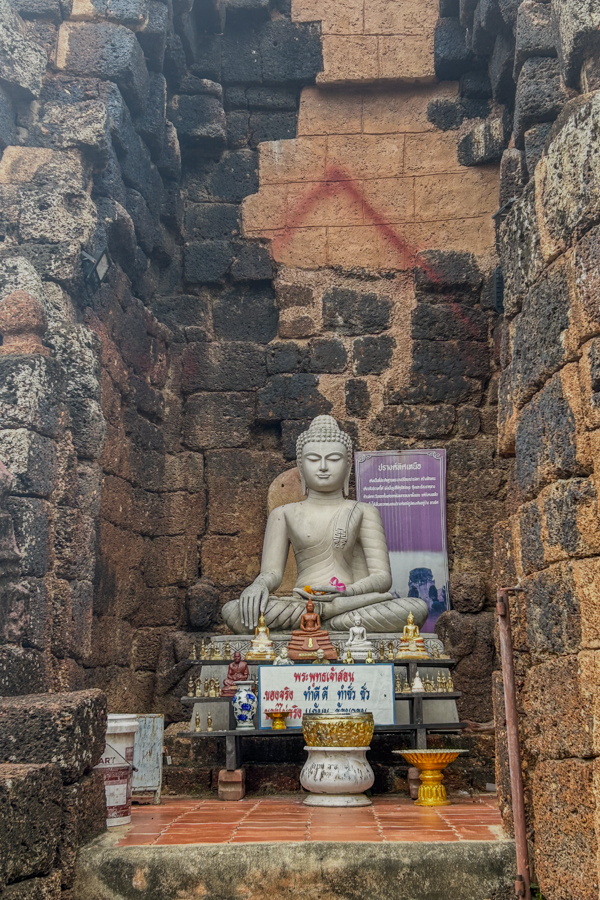

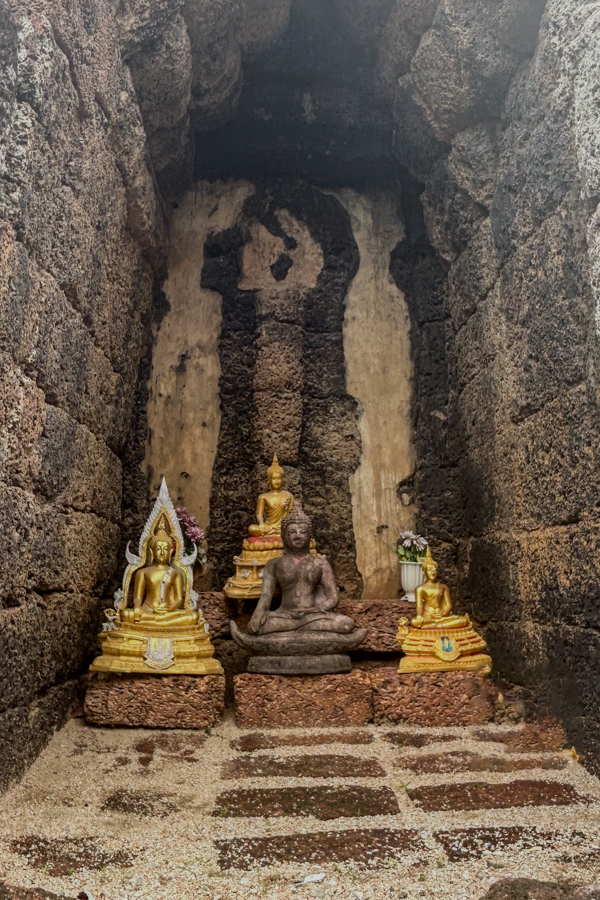

Back to the ancient history and we walk across town to another Khmer era temple, Wat Kamphaeng Laeng. It is the oldest temple, possibly the oldest building, in Phetchaburi dating back to the 12 th century with 5 very old and partly ruined prangs, each containing a buddha image and altar.
The design of the prangs are distinctive of the period with corncob shaped roofs. This is thought to be the most southern temple of the Khmer empire which was centered at Angor Wat.
The towers are made of laterite stone. Apart from the historical significance the temple is an active temple and is known for meditation.
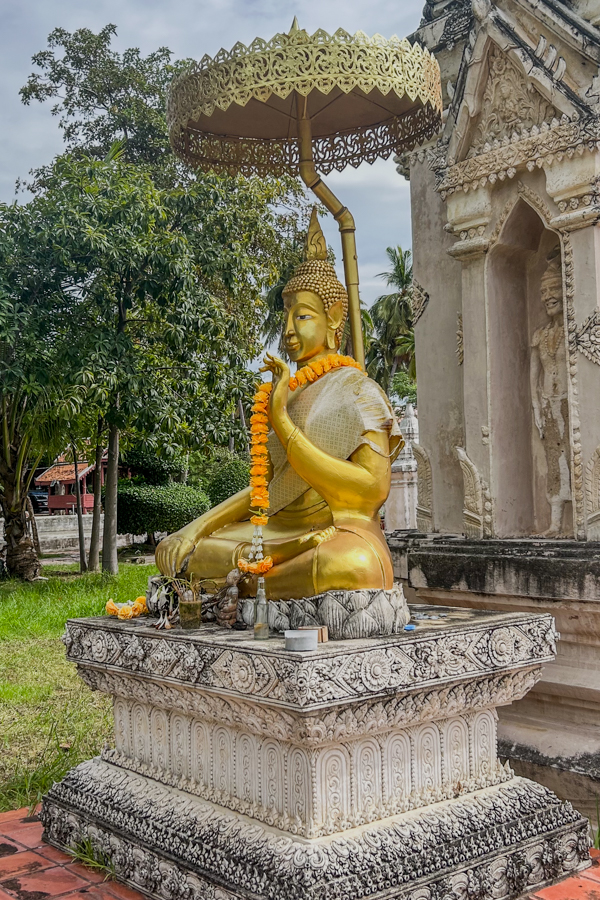
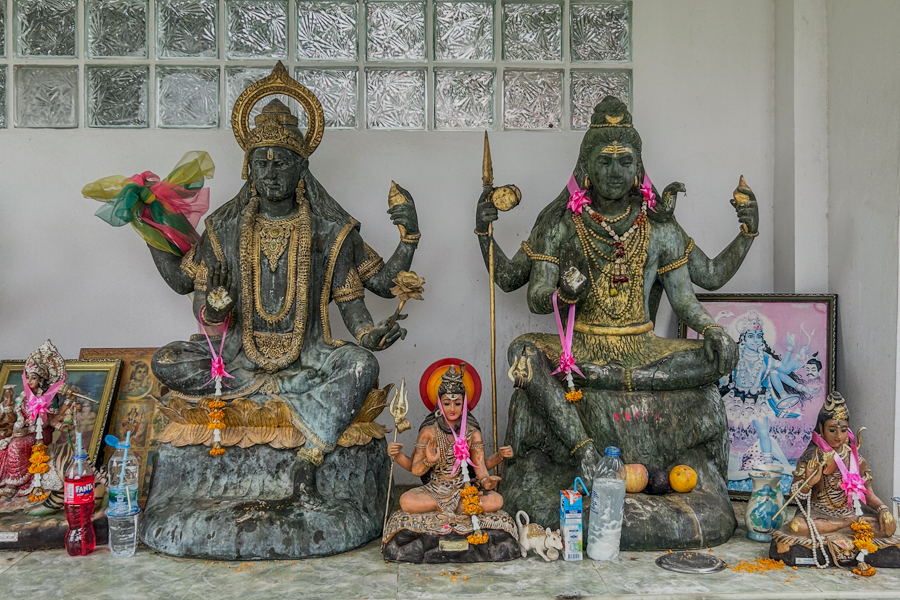
Our last temple was the Wat Phet Phili which our hosts recommended. It had a lot of Hindu imagery. All quite bright and gaudy looking. Buddhism and Hinduism have coexisted in SE Asia for centuries. In Hindusim Buddha is considered to be the 9 th reincarnation of Vishnu. When Thailand became a dominantly Buddhist country the Hindu deities were not abandoned but rather regarded as benevolent protectors which allows simultaneous veneration of Hindu gods and Buddhist teachings.
When the Thais need help with something, good luck in business, prosperity or protection they usually go to to one of the Hindu gods. Buddha is above material concerns, his role is spiritual.
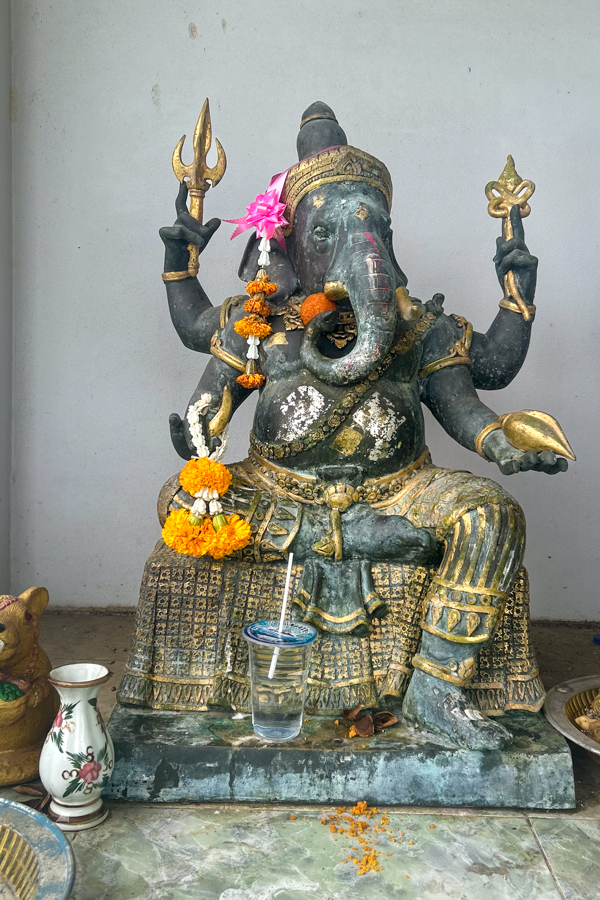

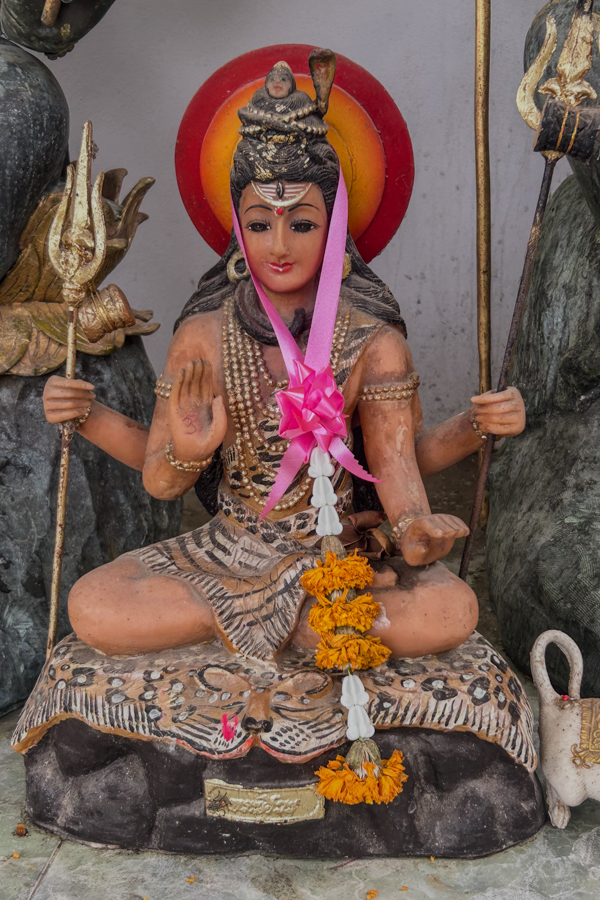
Wat Phet Phili with its myriad of Hindu gods, even mice!

More Camera Drama

So it is now our last day in Phetchaburi and we were sad to go. Because the overnight trains were unavailable to us we had booked a plane from Hua Hin to Chiang Mai, a 90 minute flight.
Our hosts were taking us to the airport in their old car, they were so excited it was like we had invited them on a day out.
We packed everything and came to load the luggage. They were very insistent that first we must have a family photo op so we went outside to use their street art as the back drop. I put everything I had been carrying down and joined them outside.
Now it was getting late and we climbed into the car and set off. Only when we were half way there did I realise that I had put the camera and my stick on the table and not in the car. Disaster
This was our one remaining "good" camera, a small compact wide angle which was still working. Without it we were really down to cell phones only. Also it had some good photos we had not yet downloaded. We did not know what to do.
Our friends said no trouble they would courier it to Chiang Mai. Not knowing if it would find us, or arrive in time, I was far from reassured but it was a plan.


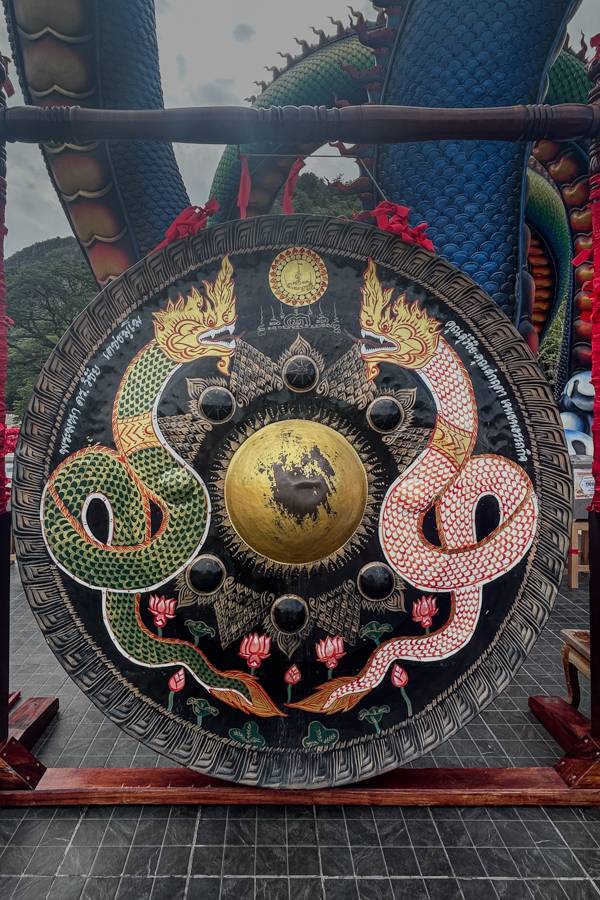

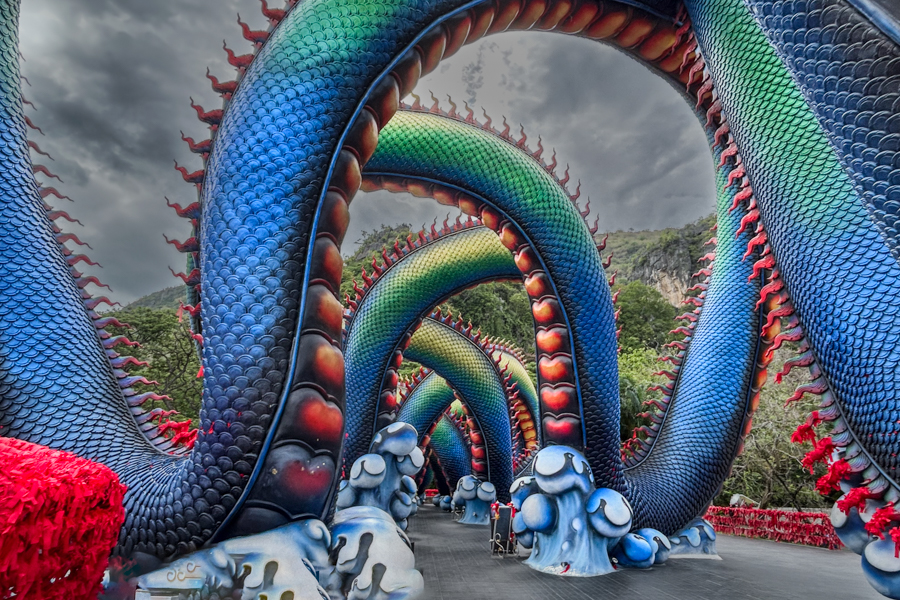
En route we pulled off the road to the biggest Naga (snake) statue I had ever seen. Mother Ay said it was their favourite temple where they came to pray for lost things or for luck or prosperity. It is the biggest Naga in Thailand.
Still agitated we got out. Well if anyone could bring the camera back it was going to be this Naga, so we donated and said a little prayer as we marvelled at the sheer scale of it.
We stepped out of the car at the airport. Our friends said don't worry, all would be well. With full hearts and broad smiles, and not a little Western scepticism, we left them and walked into the airport. Next stop Chiang Mai. Dudley was already wondering if he could buy a new camera there.